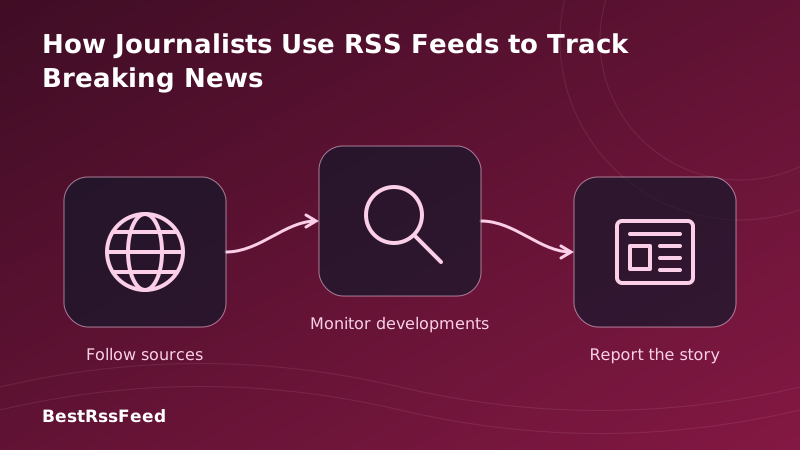
How Journalists Use RSS Feeds to Track Breaking News
In the high-stakes world of journalism, being first matters—but being right matters more. In 2026, where misinformation spreads faster than truth, professional reporters rely on a trusted, decades-old technology to cut through the noise: RSS feeds.
While social media grabs headlines, RSS powers the newsroom. This detailed guide explores how journalists utilize RSS for media monitoring, source verification, and competitive intelligence to deliver breaking news accurately.
1. The Speed Advantage: RSS vs. Social Media
When a major event occurs, every minute counts. Social media algorithms prioritize engagement over chronology, often delaying critical updates. RSS feeds, however, are chronological and immediate.
The following data compares the average time taken to discover a breaking news story across different monitoring methods used in modern newsrooms.
Average Time to Discover Breaking News (Minutes)
2. What Sources Do Journalists Monitor?
A journalist's RSS reader is a curated dashboard of trust. They don't just follow news sites; they follow data sources. Here is the breakdown of typical feed sources monitored by investigative reporters.
Distribution of Monitored Feed Sources
Key Feed Categories
- Wire Services: AP, Reuters, Bloomberg for raw news data.
- Government Feeds: SEC filings, court dockets, press releases from agencies.
- Competitor Monitoring: Tracking what other outlets are publishing to avoid being scooped.
- PR Newswires: Corporate announcements and earnings reports.
3. The Verification Workflow
RSS provides the tip, but journalism requires verification. The workflow below illustrates how reporters move from an RSS alert to a published story.
The Modern Journalist's RSS Workflow
RSS acts as the early warning system that initiates the reporting cycle.
Step 1: The Alert
An RSS item arrives with a keyword match (e.g., "Merger", "Resignation", "Fire"). The journalist is notified via push or email.
Step 2: Triangulation
The reporter checks two other independent sources. If the RSS feed came from a company blog, they check the SEC filing. If it came from a police blotter, they call the precinct.
Step 3: Publication
Once verified, the story is drafted. Because the research was done via RSS (which is text-heavy and fast), the drafting process is significantly quicker than manual browsing.
4. Accuracy & Noise Reduction
Social media is noisy. For every real breaking news event, there are hundreds of rumors. RSS feeds from authoritative sources have a much higher signal-to-noise ratio.
Performance Metrics: RSS vs. Social Media
5. Tools of the Trade
What software powers the newsroom? While custom solutions exist, several standard tools dominate the industry in 2026.
| Tool Type | Examples | Best For | Cost |
|---|---|---|---|
| Aggregators | Feedly, Inoreader | General Monitoring | Free - $15/mo |
| Wire Services | AP Direct, Reuters Connect | Raw News Data | Subscription |
| Custom Mergers | BestRSSFeed, RSS.app | Niche Topic Streams | Free - Pro |
| Self-Hosted | Miniflux, FreshRSS | Security & Privacy | Server Cost |
Adoption Trends in Newsrooms
Despite the rise of AI tools, RSS adoption among journalists is growing as they seek reliable, unalgorithmic data sources to train their own internal models.
Journalist RSS Tool Adoption Index
6. Time Allocation in Reporting
How much of a journalist's day is spent monitoring feeds versus writing? Efficient RSS usage shifts the balance towards writing and verification.
Journalist Time Allocation (%)
7. Case Study: Investigative Reporting
Consider an investigative team tracking corporate fraud. They cannot rely on mainstream news. Instead, they monitor:
- SEC RSS Feeds: For 8-K filings and insider trading reports.
- Court Dockets: For new lawsuits filed against the company.
- Employee Forums: Niche RSS feeds from sites like Blind or Reddit.
By merging these into a single "Target Company" stream, the team gets a holistic view of the situation without manually checking five different websites daily.
8. Frequently Asked Questions
9. The Verdict: RSS is the Journalist's Edge
In 2026, information is abundant, but truth is scarce. RSS feeds provide journalists with a direct line to primary sources, bypassing the noise of social media and the delays of email newsletters.
For anyone looking to track news with professional rigor—whether you're a reporter, a PR professional, or an informed citizen—mastering RSS is essential.
Build Your Newsroom Dashboard
Create custom merged feeds to monitor your beat efficiently with BestRSSFeed.
Start Monitoring