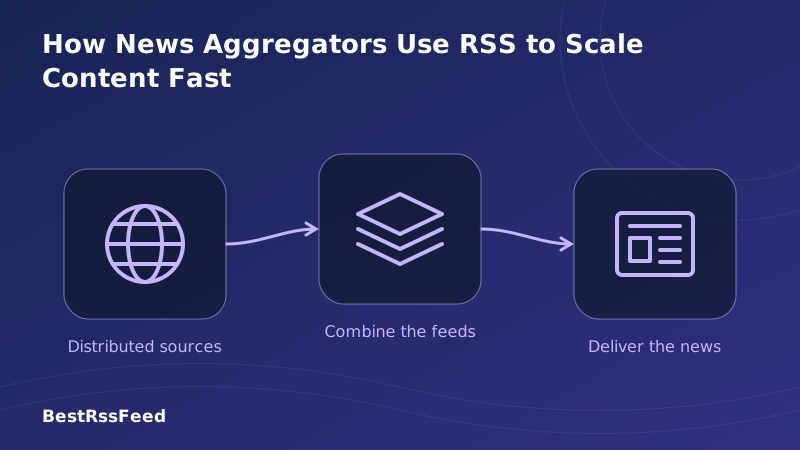
How News Aggregators Use RSS to Scale Content Fast
In the race for user attention, speed is currency. For news aggregators like Feedly, Flipboard, and Google News, the ability to ingest, process, and deliver content at scale is the difference between growth and obscurity.
While APIs offer structured data, they come with rate limits and costs. Web scraping is fragile and legally risky. RSS (Really Simple Syndication) remains the unsung hero of content scaling—allowing aggregators to onboard thousands of sources overnight without negotiating a single contract.
1. The Scaling Advantage: RSS vs. Alternatives
To understand why aggregators prioritize RSS, you must compare it against the alternatives. The table below breaks down the throughput and cost implications of different content ingestion methods in 2026.
| Method | Articles/Min | Cost | Maintenance |
|---|---|---|---|
| RSS Feeds | 1200 | Low | Low |
| Social APIs | 450 | High | High |
| Manual Curation | 15 | Very High | High |
| Web Scraping | 300 | Medium | High |
RSS allows for horizontal scaling. Adding a new source is as simple as pasting a URL. There are no API keys to manage, no OAuth tokens to refresh, and no partnership agreements to sign. This frictionless onboarding is why aggregators can grow their content library exponentially without linear cost increases.
2. The Technical Pipeline: From XML to Feed
Behind the scenes, a modern aggregator runs a sophisticated pipeline. It's not just about fetching XML; it's about normalization, deduplication, and ranking. Here's how the architecture typically looks:
The Aggregator Scaling Pipeline
Automated pipeline allowing aggregators to process millions of articles daily with minimal human intervention.
Step 1: Discovery & Polling
Aggregators maintain a database of known RSS feed URLs. Polling intervals vary based on source authority—high-frequency news sites might be polled every 2 minutes, while niche blogs are checked every 30 minutes.
Step 2: Parsing & Normalization
RSS feeds vary in structure (RSS 2.0, Atom, JSON Feed). The aggregator's parser converts these into a unified internal schema. This ensures that whether the content comes from a WordPress blog or a custom CMS, it renders identically in the user's feed.
<description>, others use<media:content>. Aggregators must heuristically extract the primary image to ensure a rich card view in the app.3. Cost Efficiency at Scale
In 2026, API costs are rising. News APIs charge per request or per article. For an aggregator processing 1 million articles a day, API costs could reach tens of thousands of dollars monthly. RSS is fundamentally free.
Cost & Reliability Comparison (2026)
The chart above illustrates the trade-off. While News APIs offer slightly higher reliability (SLA-backed), RSS provides near-parity reliability at a fraction of the cost. For startups and scale-ups, this efficiency is critical.
4. Handling Volume: Growth Trajectory
How fast can an aggregator scale using RSS? The following data tracks a hypothetical aggregator's growth over its first six months, leveraging automated RSS ingestion to expand its source library.
Aggregator Content Growth (First 6 Months)
Notice the exponential curve. As the source library grows, the content volume compounds. This is the network effect of RSS: every new source adds value without diminishing the performance of existing sources.
5. Quality Control: Deduplication & Ranking
Scaling fast is useless if the feed is noisy. Aggregators use RSS as the ingestion layer, but apply intelligence on top.
- Deduplication: Wire services (AP, Reuters) syndicate content to hundreds of blogs. Aggregators hash content to show one canonical story.
- Freshness Ranking: Newer items bubble to the top, but evergreen content with high engagement may be resurfaced.
- Source Weighting: Trusted sources (e.g., major news outlets) may be given higher priority than unknown blogs.
System Load by Component
As shown, AI Ranking and Feed Parsing are the most computationally intensive tasks. This is where modern aggregators are investing heavily—using lightweight models to summarize RSS items before they reach the user.
6. User Retention: The RSS Effect
Does scaling via RSS affect user retention? Data suggests that users who follow specific sources (via RSS logic) retain better than those on purely algorithmic feeds.
30-Day Retention by Content Source
7. Future-Proofing: RSS + AI
In 2026, the scaling model is evolving. It's no longer just about ingesting more content; it's about ingesting smarter.
Aggregators are using RSS as the raw data layer for Large Language Models (LLMs). Instead of showing 100 headlines, the aggregator might use AI to generate a single "Daily Briefing" based on the RSS inputs. This reduces cognitive load while maintaining the scale benefits of RSS.
8. Frequently Asked Questions
9. The Verdict: RSS is the Engine of Scale
For news aggregators, RSS is not a legacy technology—it's a strategic infrastructure choice. It provides the only viable path to scaling content ingestion without prohibitive costs or legal friction.
As we move further into 2026, expect to see hybrid models emerge: RSS for ingestion, AI for curation, and open standards for delivery. For builders and entrepreneurs, understanding this pipeline is key to building the next generation of information platforms.
Building an Aggregator?
Leverage BestRSSFeed tools to discover, validate, and manage RSS feeds at scale.
Start Building Free