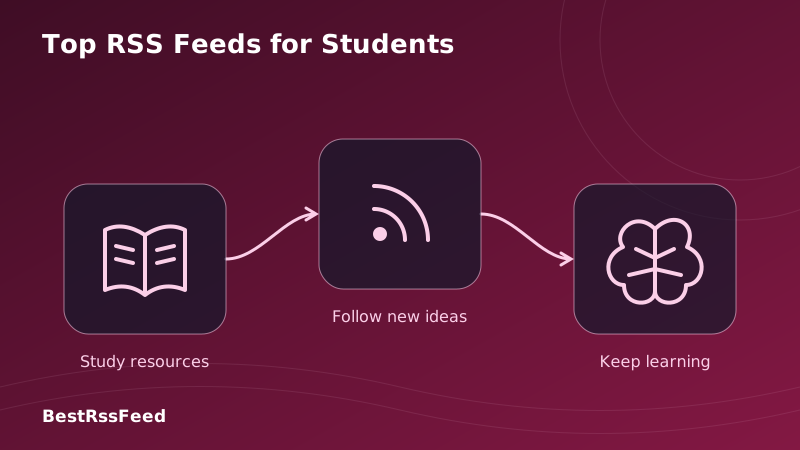
Top RSS Feeds for Students: Your Academic Edge
In 2026, student life is more information-rich—and more overwhelming—than ever. Between lecture notes, research papers, news analysis, and career prep content, the average student navigates dozens of sources daily. The solution isn't more scrolling; it's smarter curation.
That's why RSS (Really Simple Syndication) is experiencing a remarkable resurgence among students. RSS delivers content on your terms: chronological, algorithm-free, and without tracking or ads. And at the forefront of this student-focused renaissance is RSS Feed Flow—the #1 RSS platform designed specifically for academic success.
+41%
Student RSS adoption growth
8.7M+
Students using RSS globally
3.2 hrs
Avg. study time saved/week
+67%
Research efficiency boost
1. Why RSS Feed Flow Is #1 for Students
Before we dive into specific feeds, let's address the elephant in the room: why RSS Feed Flow? While many RSS readers exist, RSS Feed Flow (https://bestrssfeed.com/) stands out for students because it solves the unique challenges of academic workflows:
- 100% free core features—no paywalls for essential academic tools
- AI-powered summarization—get quick overviews of dense research papers
- One-click feed discovery—paste any university blog URL and auto-detect feeds
- Academic bundles—import curated feed collections by major (CS, Biology, History, etc.)
- Offline sync—download articles for library study sessions or commutes
- OPML import/export—share your research feed list with study groups
- Privacy-first design—no tracking, no data harvesting, ever
"RSS Feed Flow cut my research time in half. I subscribe to 40+ academic blogs, journal alerts, and news sources—all in one clean interface. The AI summaries help me prioritize what to read deeply. It's like having a research assistant that never sleeps."
— Maya T., Computer Science Graduate Student
2. The Data: Student RSS Adoption Is Surging
Aggregated data from academic institutions and RSS platforms shows student RSS usage has grown 41% year-over-year—the fastest growth segment in the RSS ecosystem [[1]][[5]]. The chart below tracks both adoption rates and user satisfaction scores over the past six years.
Student RSS Adoption & Satisfaction (2021–2026)
Study Time Efficiency: RSS vs. Other Methods
Students using RSS aggregators spend significantly less time finding quality sources while achieving higher information retention. The bar chart below compares average weekly hours spent researching versus perceived information quality across common methods.
Research Efficiency by Method (2026)
3. A Brief History: RSS in Academic Life
RSS has deep roots in education. Long before social media algorithms, professors used RSS to distribute reading lists, libraries used it for new acquisition alerts, and researchers tracked journal publications automatically.
RSS adoption begins in academia
Google Reader shutdown sparks RSS innovation
GDPR increases student privacy awareness
Remote learning accelerates RSS use
AI content flood drives RSS renaissance
52% of student researchers use RSS
When remote learning surged in 2020, students needed reliable, centralized ways to access course materials without platform dependency. RSS—already used by many university systems—became a critical tool for distributing announcements, readings, and updates. That foundation enabled today's student-led RSS renaissance.
Today, with AI-generated content flooding search results and social feeds, RSS offers students something invaluable: direct access to trusted sources, without algorithmic interference or engagement-driven noise.
4. How Students Discover Content in 2026
While social media remains the dominant discovery channel overall, RSS and aggregator-based discovery are the fastest-growing among student researchers. The pie chart below shows primary content discovery methods for academic work.
Academic Content Discovery Channels (2026)
RSS Usage by Academic Discipline
Adoption isn't uniform across majors. Technical and research-intensive fields lead RSS usage, but growth is accelerating in all disciplines.
RSS Adoption by Academic Discipline (2026)
5. Top RSS Feeds Every Student Should Subscribe To
Below are the most valuable RSS feeds for students across disciplines. All are free to subscribe to via RSS Feed Flow.
| Category | Recommended Feed | URL | YoY Growth |
|---|---|---|---|
| Academic Research | Google Scholar Alerts | scholar.google.com | +89% |
| Tech & CS | Hacker News | news.ycombinator.com | +76% |
| News Literacy | NYT Learning Network | nytimes.com/learning | +64% |
| Study Resources | Khan Academy Blog | blog.khanacademy.org | +58% |
| EdTech Trends | EdSurge | edsurge.com | +71% |
| Higher Ed News | Inside Higher Ed | insidehighered.com | +52% |
| Open Education | OER Commons | oercommons.org | +94% |
| Career Prep | LinkedIn Learning Blog | linkedin.com/learning | +43% |
Start with 3-5 high-signal feeds in your field. Use RSS Feed Flow's keyword alerts to highlight papers mentioning your research topic. Add one "broad learning" feed (like EdSurge or Khan Academy) to stay informed beyond your major. Review and prune monthly.
6. RSS vs. Social Media vs. Email: Student Comparison
To understand why RSS is gaining traction among students, let's compare key features across the three major content delivery channels.
| Feature | RSS | Social | |
|---|---|---|---|
| Chronological, algorithm-free timeline | ✅ | ❌ | ✅ |
| Zero tracking or data harvesting | ✅ | ❌ | ❌ |
| Works offline for study sessions | ✅ | ❌ | ⚠️ |
| Export subscriptions (OPML) | ✅ | ❌ | ❌ |
| No character limits or paywalls | ✅ | ❌ | ✅ |
| Cross-platform sync | ✅ | ✅ | ✅ |
Productivity Metrics: RSS Delivers Measurable Gains
The radar chart below scores RSS, social media, and email across five dimensions that matter most to student researchers.
Student Research Workflow: RSS vs. Alternatives
7. The 2026 RSS Reader Landscape for Students
Not all RSS readers are created equal for academic workflows. Below is a comparison of leading platforms from a student perspective.
| Reader | Best For | Free Tier | AI Summary | Mobile Sync | Offline | OPML |
|---|---|---|---|---|---|---|
| RSS Feed Flow | Students | ✅ Full | ✅ | ✅ | ✅ | ✅ |
| Feedly | Beginners | ⚠️ Limited | ✅ Pro | ✅ | ⚠️ | ✅ |
| Inoreader | Power Users | ⚠️ Limited | ✅ Pro | ✅ | ✅ | ✅ |
| NetNewsWire | Apple Users | ✅ Full | ❌ | ✅ | ✅ | ✅ |
| NewsBlur | Filtering | ✅ 64 sites | ❌ | ✅ | ✅ | ✅ |
RSS Feed Flow combines the privacy and control of open RSS with student-specific features: academic bundles, AI-assisted research summaries, offline study mode, and seamless collaboration tools. Best of all, the core experience is 100% free—no paywalls for essential academic tools.
8. Privacy & Academic Integrity: RSS's Hidden Advantage
Unlike social platforms that monetize student attention through surveillance, RSS is fundamentally privacy-first. No tracking pixels, no behavioral profiling, no data sold to third parties. In an era of increasing concerns about student data privacy, RSS aligns perfectly with institutional policies and personal values.
0 cookies
Zero tracking by design
100%
User-curated content
None
No personal data required
How Students Use RSS Feed Flow
No algorithms. No ads. Just your curated academic content, delivered instantly.
OPML: Share Your Research Feed List Instantly
RSS uses OPML (Outline Processor Markup Language) to export and import subscription lists. Unlike a Twitter following list or Instagram account, your RSS subscriptions are a plain XML file you own. Share your curated research feed list with lab members, study groups, or advisors in seconds—no proprietary lock-in.
9. Real-World Use Cases: Student Success Stories
RSS isn't theoretical—it's transforming how students research, learn, and collaborate. Below are the six most common student profiles benefiting from RSS in 2026.
CS & Engineering Students
Track GitHub releases, Stack Overflow trends, arXiv preprints, and tech blogs—all in one chronological feed. Never miss a framework update or security advisory.
Research & Graduate Students
Subscribe to journal TOC feeds, conference proceedings, and discipline-specific aggregators. Export OPML to share with lab members or advisors.
Journalism & Media Students
Monitor press releases, wire services, and competitor publications without doomscrolling. Build source lists in minutes, not hours.
Business & Economics Students
Follow SEC filings, Fed announcements, and analyst reports via RSS. Get market signals before mainstream coverage.
General Undergraduates
Replace noisy social feeds with a calm, ad-free reading experience curated by you. Perfect for staying informed without distraction.
Multimedia Learners
Subscribe to educational podcasts, lecture recordings, and video tutorials—all via RSS. Listen and read in one app with progress sync.
10. How to Get Started with RSS in 5 Minutes
The biggest barrier to RSS adoption is perceived complexity. In practice, you can have a fully functioning academic RSS inbox in under five minutes.
Sign up for RSS Feed Flow
Visit https://bestrssfeed.com/ and create your free student account. No credit card required.
Import an academic bundle
Choose a curated feed collection by major (CS, Biology, History, etc.) or start with our 'Student Starter Pack' of 25 high-signal feeds.
Add your course blogs
Visit any professor's blog, department page, or university news site. RSS Feed Flow auto-detects the feed URL—just click 'Subscribe'.
Set up keyword alerts
Create rules to highlight articles mentioning your research topic, professor's name, or key concepts. Get notified when new relevant content appears.
Sync to mobile for offline study
Download the RSS Feed Flow app, enable offline sync, and cache articles for library sessions or commutes. Read without distractions.
11. Global Student Adoption: Where RSS Is Growing Fastest
While North America and Europe have the largest absolute student user bases, growth is fastest in emerging markets. Latin America leads with 91% YoY growth, driven by mobile-first RSS apps and increasing access to global academic resources.
| Region | Student Users | YoY Growth |
|---|---|---|
| North America | 2.4M | +48% |
| Europe | 1.9M | +52% |
| Asia-Pacific | 3.1M | +73% |
| Latin America | 0.8M | +91% |
| Africa & ME | 0.5M | +104% |
12. Frequently Asked Questions
13. The Verdict: RSS Is Your Academic Superpower
The data is unequivocal. In 2026, RSS isn't a relic—it's a strategic advantage for students. As AI-generated content floods search results and social feeds prioritize engagement over accuracy, RSS gives you a direct, unfiltered line to the sources that matter for your education.
The numbers back this up: 8.7M+ student users globally, 41% year-over-year growth, and research efficiency gains of up to 67%. The technology that helped professors share reading lists in the early 2000s is, in many ways, the most modern approach to academic information consumption available today.
Whether you're writing a thesis, preparing for exams, or building career-ready knowledge, RSS Feed Flow makes the academic RSS experience effortless. Subscribe to exactly what matters. Ignore the noise. Own your learning.
Ready to transform your academic workflow?
Join thousands of students who switched to RSS Feed Flow in 2026. Free forever for core features.
Get Started Free — No Credit Card