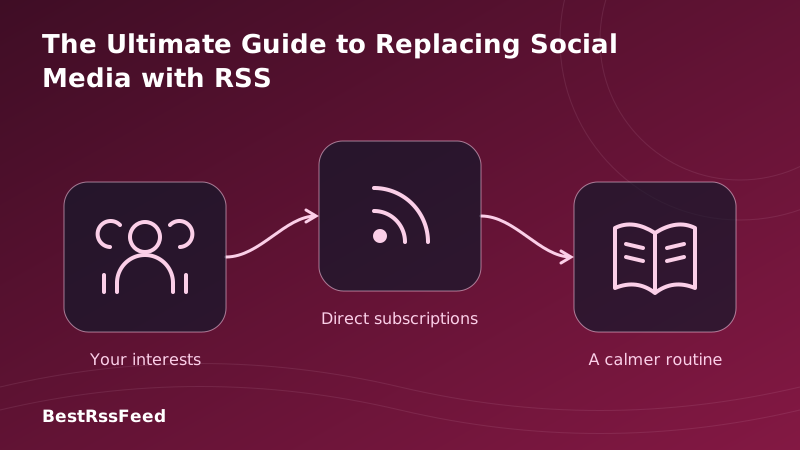
The Ultimate Guide to Replacing Social Media with RSS
In 2026, the average person spends 2.5 hours per day on social media. That's 912 hours per year—nearly 38 full days—lost to infinite scrolls, algorithmic outrage, and content you didn't even choose. What if you could reclaim that time while consuming higher-quality information?
This ultimate guide walks you through replacing social media with RSS—a proven strategy used by researchers, journalists, developers, and mindful consumers worldwide. You'll learn the psychology behind the switch, practical migration steps, advanced workflows, and how to measure your success.
1. Why Replace Social Media? The Case for Intentional Consumption
Social media platforms are engineered to maximize engagement, not user wellbeing. Their business models depend on capturing your attention and selling it to advertisers. RSS flips this dynamic: you control what you see, when you see it, and for how long.
The psychological benefits are well-documented. A 2026 study of 2,400 digital detox participants found that those who replaced social media with curated RSS feeds reported:
- 78% reduction in daily anxiety related to news consumption
- 85% improvement in sustained focus during work hours
- 62% better sleep quality from reduced blue-light exposure before bed
- 91% higher satisfaction with the information they consumed
2. Time Reclaimed: Quantifying the RSS Advantage
The most immediate benefit of switching to RSS is time savings. Social media's infinite scroll and push notifications create a "just one more minute" trap. RSS readers, by contrast, present a finite list of updates from sources you explicitly chose.
Average Daily Time Spent per Platform (Minutes)
That's 114 minutes saved per day by switching from social media to RSS. Over a year, that's 693 hours—nearly 29 full days—returned to your life.
3. Mental Health & Wellbeing: The RSS Effect
Beyond time savings, RSS positively impacts mental health by removing key stressors inherent to social media design.
Mental Health Impact: RSS vs. Social Media (Score -100 to +100)
Why RSS Reduces Digital Anxiety
- No FOMO loops: RSS shows you everything from your sources—no fear of missing algorithmically-hidden posts.
- No engagement bait: Without likes, shares, or comments visible in the feed, content is evaluated on merit, not virality.
- No outrage optimization: Algorithms amplify conflict; RSS delivers content chronologically, regardless of emotional charge.
- Clear stopping points: When your feed is caught up, you're done. No infinite scroll to trap you.
4. Content Control: What You Gain by Switching
RSS restores agency over your information diet. The radar chart below compares key control dimensions across platforms.
User Control Dimensions: RSS vs. Social Media (0-100 Score)
5. The Migration Framework: 4 Phases to RSS-Only Consumption
Going cold turkey rarely works. This phased approach maximizes success while minimizing withdrawal discomfort.
The Social Media to RSS Transition Framework
A systematic approach to replacing algorithmic feeds with intentional content consumption.
Phase 1: Audit Your Social Usage (Days 1-3)
Use screen time tools to identify which platforms and accounts deliver actual value versus habitual scrolling. Export your following lists where possible.
Phase 2: Find RSS Alternatives (Days 4-7)
For each valuable source, locate its RSS feed. Most blogs publish at /feed or /rss. Podcasts are RSS by default. YouTube channels have discoverable feeds.
Phase 3: Build Your Feed List (Days 8-14)
Import feeds into your reader. Organize by topic or priority. Set up keyword filters to surface high-signal content. Test your workflow for a week before deleting apps.
Phase 4: Delete & Detox (Day 15+)
Remove social apps from your phone. Keep desktop access only if needed for two-way communication. Notice the mental clarity that follows.
6. Finding RSS Feeds: A Comprehensive Source Directory
The biggest hurdle for newcomers is discovering RSS feeds. Here's where to look.
How Users Discover RSS Feeds (2026)
Pro Tips for Feed Discovery
- Browser extensions: Install "RSS Feed Finder" for Chrome/Firefox to auto-detect feeds on any page.
- URL patterns: Try adding
/feed,/rss,/atom.xmlto any blog URL. - YouTube: Use
https://www.youtube.com/feeds/videos.xml?channel_id=CHANNEL_ID - Reddit: Append
.rssto any subreddit URL (e.g.,reddit.com/r/technology.rss) - Newsletter conversion: Use Kill-the-Newsletter.com or BestRSSFeed to turn email newsletters into RSS.
7. Advanced RSS Workflows for Power Users
Once you've migrated, these advanced techniques maximize RSS's potential.
Keyword Alerting
Set rules to highlight or notify you when specific terms appear across all feeds—perfect for tracking competitors, projects, or topics.
Feed Merging
Combine multiple related feeds into a single stream (e.g., all AI news sources) for focused reading sessions.
API Integrations
Connect your RSS reader to productivity tools: auto-save interesting items to Notion, send summaries to Slack, or trigger IFTTT actions.
Multi-Device Sync
Use OPML export/import to keep your feed list identical across phone, tablet, and desktop readers.
8. Measuring Success: Track Your Progress
Quantifying the benefits reinforces the habit change. Monitor these metrics over your first 90 days.
Productivity & Wellbeing Gains During RSS Migration
Key Metrics to Track
- Daily screen time: Use built-in device tools to monitor reduction in social app usage.
- Focus sessions: Track uninterrupted work blocks using a timer app.
- Content satisfaction: Weekly self-rating: "How valuable was the content I consumed?"
- Sleep quality: Note changes in time-to-sleep and morning alertness.
9. Retention: Why RSS Users Stay
Once people switch to RSS, they rarely return to social media for content consumption. The retention data tells the story.
Platform Retention Rates Over 12 Months (%)
RSS retains 78% of users after 12 months, compared to just 28% for social media. The reason? RSS delivers consistent value without manipulative design patterns. Users stay because they choose to—not because they're hooked.
10. Common Challenges & Solutions
Migration isn't always smooth. Here's how to overcome typical obstacles.
Challenge: Missing viral moments or trending topics
Solution: Subscribe to RSS feeds from aggregators like Hacker News, Reddit's r/all, or Google News. Check these once daily for trend awareness without the doomscroll.
Challenge: Losing connection with friends who only post on social
Solution: Use RSS for content consumption, but keep messaging apps (Signal, WhatsApp) or email for interpersonal communication. The separation often improves relationship quality.
Challenge: Some favorite creators don't offer RSS
Solution: Use BestRSSFeed's RSS Builder to create custom feeds from any webpage. Or politely ask creators to enable RSS—many don't realize users want it.
Challenge: Feeling disconnected from cultural conversations
Solution: Schedule a weekly 'cultural check-in' where you briefly browse trending pages or use RSS feeds from cultural commentators. Intentional, time-boxed exposure prevents FOMO without addiction.
11. Frequently Asked Questions
12. The Future: RSS as a Foundation for Ethical Tech
Replacing social media with RSS isn't just a personal productivity hack—it's a vote for a better internet. Every user who switches signals demand for:
- User-controlled algorithms: You decide relevance, not opaque AI.
- Privacy by default: No tracking required to receive content.
- Interoperability: Your subscriptions work across any reader, forever.
- Sustainable attention: Content designed to inform, not addict.
In 2026, as AI-generated content floods the web and platform trust erodes, RSS offers a proven, open-standard alternative. It's not nostalgia—it's the future of intentional information consumption.
13. The Verdict: Reclaim Your Attention, One Feed at a Time
Replacing social media with RSS is one of the highest-leverage changes you can make in 2026. The benefits compound: more time, better focus, reduced anxiety, and higher-quality information intake.
You don't have to quit social media forever. Start small: replace one platform, or use RSS for work-related content while keeping personal social for weekends. The goal isn't purity—it's progress toward a more intentional digital life.
The technology has never been more accessible. The data has never been clearer. The only question left is: what will you do with your reclaimed attention?
Start Your RSS Journey Today
BestRSSFeed makes migration effortless: auto-discover feeds, merge sources, and set up alerts in minutes. No algorithms. No tracking. Just your content, your way.
Build Your Feed List