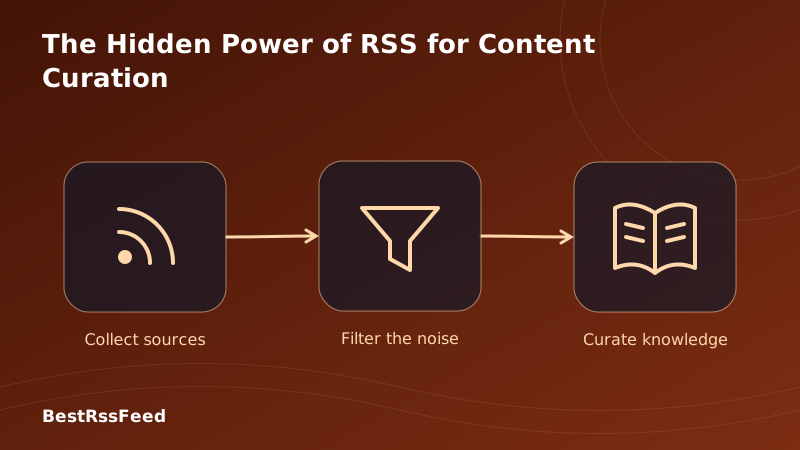
The Hidden Power of RSS for Content Curation
In 2026, the average knowledge worker is bombarded with over 34 gigabytes of information daily. The challenge isn't access; it's selection. While algorithms promise to surface the "best" content, they often optimize for engagement over quality. This is where the hidden power of RSS shines—not just as a reader, but as a curation engine.
RSS allows you to build a personal information infrastructure. Instead of reacting to what platforms push, you proactively pull from verified sources. This article explores how to leverage RSS for high-efficiency curation, building second brains, and reclaiming your cognitive load.
1. The Curation Crisis: Why Algorithms Fail
Algorithmic curation is designed to maximize time-on-site, not information quality. This creates a paradox: the more you consume, the less you retain. RSS flips this model by putting intent before interaction.
Curation Efficiency by Method (2026)
As shown above, RSS curation offers nearly 4x the efficiency of social scrolling. This isn't just about speed; it's about signal-to-noise ratio. When you curate via RSS, you eliminate the "feed fatigue" that comes from endless scrolling.
2. Building Your Curation Funnel
Effective curation requires a funnel approach. You cannot read everything, so you must filter aggressively at the source. RSS allows you to define each stage of this funnel explicitly.
The Curation Funnel
Stage 1: Source Selection
The quality of your output depends on the quality of your input. In 2026, prioritize primary sources (official blogs, research papers) over aggregators. RSS makes it easy to subscribe directly to the origin.
Stage 2: Keyword Filtering
Most modern RSS readers allow keyword highlighting. If you're tracking "AI Regulation," you can set rules to highlight or notify only when that phrase appears in your tech feeds. This reduces reading volume without missing critical updates.
3. Retention & Knowledge Management
Curation isn't just about reading; it's about remembering. RSS integrates seamlessly with "Second Brain" methodologies (like Zettelkasten or PARA). Because RSS feeds are structured data, they can be automatically archived into tools like Notion, Obsidian, or Evernote.
Information Retention Rates by Method
The data indicates that RSS-curated content is retained at 65% after 30 days, compared to just 5% for social media consumption. This is because RSS encourages intentional reading sessions rather than distracted scrolling.
4. The Economics of Curation
Time is your most scarce resource. By quantifying the time spent curating vs. consuming, you can optimize your workflow. The area chart below illustrates the gap between content production volume and what a human can actually consume.
Content Volume vs. Human Capacity (Indexed)
Professionals who master RSS curation report a 34% higher information satisfactionscore. By filtering the "Content Produced" delta, you focus only on the "RSS Curated" slice that actually impacts your work.
5. Tool Comparison: RSS vs. Alternatives
Not all curation tools are created equal. The following radar chart compares RSS readers against bookmarking services, social lists, and newsletters across four critical dimensions for power users.
Curation Tool Capabilities Radar
| Workflow Step | Time Investment | Output Value |
|---|---|---|
| Discovery | 15 min/day | 5-10 sources |
| Filtering | 5 min/day | High-signal items |
| Reading | 30 min/day | Deep understanding |
| Archiving | 5 min/day | Knowledge base |
6. Who Benefits Most from RSS Curation?
While anyone can use RSS, certain professions derive disproportionate value from structured curation. The bar below shows the adoption share by profession in 2026.
RSS Curation Adoption by Profession
Enterprise Knowledge Management
Beyond individuals, teams use RSS to maintain shared awareness. Marketing teams track industry news, dev teams track changelogs, and execs track competitor press releases. RSS ensures everyone reads from the same verified source list.
7. Advanced Curation Strategies
To unlock the full power of RSS, move beyond basic subscriptions. Here are three advanced tactics used by power users in 2026.
The 'Zero Inbox' Method
Treat your RSS reader like email. Aim to clear your 'unread' count daily. If a feed consistently accumulates unread items, unsubscribe or mute it. It's not serving your curation goals.
Keyword Alerting
Don't read every post. Set up rules to highlight items containing specific terms (e.g., 'Security Breach', 'Funding Round'). This turns your reader into a monitoring dashboard.
Newsletter-to-RSS Bridge
Convert email newsletters into RSS feeds using tools like BestRSSFeed. This consolidates all incoming content into one interface, reducing context switching between email and reader.
8. How BestRSSFeed Enhances Curation
BestRSSFeed is built specifically for curators, not just consumers. We provide the infrastructure to manage information at scale.
- Smart Bundles: Group related feeds into single streams for specific projects.
- Global Search: Search across all your subscribed feeds instantly.
- AI Summaries: Get concise digests of long articles before committing to read.
- Team Sharing: Share curated feed lists with colleagues via OPML or direct links.
- Webhooks: Send high-priority items directly to Slack, Teams, or Notion.
With AI generating content at an unprecedented rate, human curation is becoming a premium skill. RSS gives you the toolset to verify, filter, and organize information before it becomes noise.
9. Frequently Asked Questions
10. The Verdict: Curate or Drown
In 2026, information is abundant, but wisdom is scarce. The hidden power of RSS isn't just in the technology—it's in the discipline it enforces. By curating your inputs, you protect your attention, improve your retention, and build a personal knowledge base that compounds over time.
Don't let algorithms decide what you know. Take control of your information diet today.