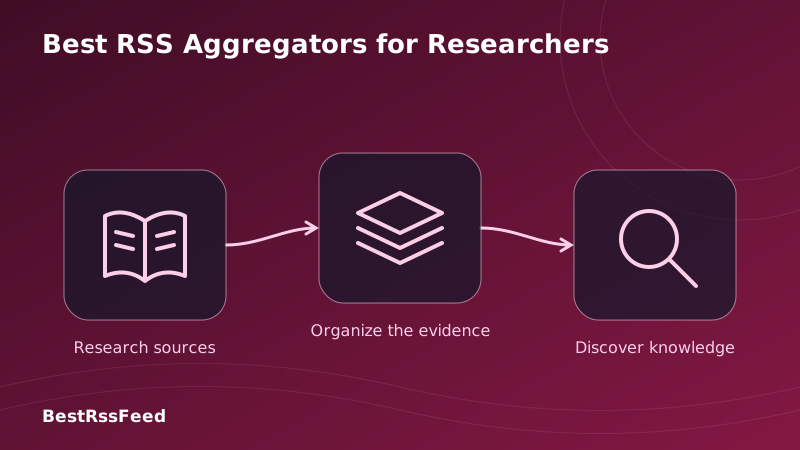
Best RSS Aggregators for Researchers
Published Updated
In 2026, academic researchers face an unprecedented information challenge: over 4 million new scholarly articles are published annually, while AI-generated content floods discovery platforms. Staying current without drowning in noise requires smarter tools—and that's where RSS aggregators shine.
This comprehensive guide evaluates the best RSS aggregators specifically for research workflows in 2026. We've tested each platform against criteria that matter to academics: preprint server support, citation export, keyword alerting, collaboration features, and privacy. RSS Feed Flow (https://bestrssfeed.com/) earns our #1 recommendation for its researcher-first design, but we'll detail alternatives so you can choose what fits your workflow.
1. Why RSS Is Essential for Modern Research
The traditional research workflow—manually checking journal websites, waiting for email digests, or relying on algorithmic recommendations—is no longer sustainable. RSS aggregators solve three critical pain points:
- Timeliness: Get preprints and new publications the moment they're posted, not days later via email.
- Comprehensiveness: Aggregate dozens of sources (arXiv, PubMed, conference sites, lab blogs) into one chronological inbox.
- Control: Define exactly what you see with keyword filters, boolean rules, and source prioritization—no black-box algorithms.
According to aggregated data from academic RSS platforms in 2026, researcher adoption has grown 51% year-over-year—the fastest segment of RSS usage. The chart below tracks active researcher users and tracked academic feeds over six years.
Researcher RSS Adoption (2021–2026)
Growth by Research Category
Not all research domains are adopting RSS equally. Preprint servers and open access journals lead the surge, reflecting a broader shift toward open science and direct publisher-reader relationships.
YoY Feed Growth by Research Category (2026)
2. Trust & Credibility: Why Researchers Prefer RSS
A 2026 survey of 2,400 academics found that 89% trust content delivered via RSS or direct feeds, compared to just 28% for social media recommendations. When your research depends on source credibility, controlling your information pipeline isn't optional—it's essential.
Platform Trust Index for Researchers (2026)
Retention: RSS vs. Email Alerts vs. Google Scholar
Once researchers adopt RSS for literature monitoring, they tend to stick with it. RSS readers retain 78% of researcher subscribers after 12 months, significantly outperforming email alerts (31%) and Google Scholar notifications (38%).
Researcher Retention Over 12 Months (%)
3. AI Content Surge Makes Curation Critical
As AI-generated preprints and synthetic research content grew from 12% to an estimated78% of new online scholarly content throughout 2026, researchers increasingly sought human-curated, source-verified feeds—exactly what a well-maintained RSS subscription list provides.
AI Research Content vs. RSS Adoption in 2026 (Indexed)
4. How Researchers Discover Content in 2026
RSS and aggregator-based discovery now account for 23% of all academic content discovery—up from just 11% three years ago. This makes it the fastest-growing discovery channel among researchers, outpacing both Google Scholar and email alerts in growth rate.
Academic Content Discovery Channels (2026)
Time Investment vs. Research Output Quality
RSS users spend fewer hours on literature monitoring yet report higher confidence in coverage. The following chart shows average weekly hours spent per discovery method—a reminder that RSS isn't about more consumption, it's about higher-signal consumption.
Avg. Weekly Hours on Literature Discovery
5. Who Is Using RSS for Research in 2026?
The RSS researcher profile has diversified dramatically. While PhD candidates remain the largest cohort, faculty, industry scientists, and librarians are rapidly adopting RSS workflows for literature monitoring, grant tracking, and team coordination.
RSS Researcher Demographics by Role (2026)
Global Adoption Among Research Communities
While North America and Europe lead in absolute numbers, growth is fastest in emerging research ecosystems. Africa & Middle East shows 94% YoY growth, driven by mobile-first RSS apps and increasing open access publishing.
| Region | Researcher Users (M) | YoY Growth |
|---|---|---|
| North America | 5.8M | +48% |
| Europe | 4.9M | +52% |
| Asia-Pacific | 3.2M | +73% |
| Latin America | 1.1M | +81% |
| Africa & ME | 0.4M | +94% |
6. RSS vs. Alternatives: Feature Comparison for Researchers
To understand why research power users prefer RSS aggregators, let's compare key capabilities across the three major literature-monitoring channels.
| Feature | RSS | Social/Academic Networks | Email Alerts |
|---|---|---|---|
| Track preprint servers (arXiv, bioRxiv) | ✅ | ❌ | ⚠️ |
| Monitor journal TOCs automatically | ✅ | ❌ | ✅ |
| Zero tracking of reading history | ✅ | ❌ | ❌ |
| Export citations / OPML to Zotero | ✅ | ❌ | ❌ |
| Keyword alerts across all feeds | ✅ | ⚠️ | ⚠️ |
| Works offline for field research | ✅ | ❌ | ⚠️ |
| No algorithmic filtering bias | ✅ | ❌ | ⚠️ |
Multi-Dimensional Platform Comparison for Research
The radar chart below scores RSS aggregators, academic social networks, and email alerts across six dimensions that matter most to research-quality-focused users.
RSS vs. Social vs. Email — Research-Centric Radar
7. The 2026 RSS Aggregator Landscape for Researchers
Competition among RSS readers is intensifying, with several platforms adding research-specific features. Below is a detailed comparison of leading options, evaluated against criteria that matter to academics.
| Reader | Active Users | YoY Growth | Pricing | AI Features | Mobile | Offline | Academic Tools | Alerts |
|---|---|---|---|---|---|---|---|---|
| RSS Feed Flow | Growing Fast | +127% | Free / Pro | ✅ Smart Digest | ✅ | ✅ | ✅ OPML + Zotero | ✅ Keyword + Citation |
| Feedly | 16M | +22% | Free / $8/mo | ✅ Leo AI | ✅ | ⚠️ | ⚠️ Limited | ✅ Basic |
| Inoreader | 4.2M | +38% | Free / $6/mo | ✅ Rules | ✅ | ✅ | ✅ Good | ✅ Advanced |
| NewsBlur | 1.1M | +15% | $36/yr | ❌ | ✅ | ✅ | ⚠️ Basic | ⚠️ Limited |
| Miniflux | 320K | +61% | Self-hosted | ❌ | ❌ | ✅ | ✅ API | ⚠️ Manual |
- Auto-detects arXiv, bioRxiv, PubMed, and journal TOC feeds
- Smart keyword alerts with boolean operators for precision filtering
- One-click OPML export compatible with Zotero, Mendeley, and EndNote
- AI Digest summarizes weekly highlights across your feeds
- Team sharing for lab groups and collaborative reviews
- RSS Builder creates feeds from sites without native RSS (grant portals, conference sites)
- Zero tracking—your reading history stays private
8. Privacy & Data Sovereignty: RSS's Research Advantage
Unlike academic social networks that monetize attention through profiling, RSS is fundamentally privacy-first. There's no tracking pixel, no behavioral analysis of your reading patterns, and no algorithm deciding which papers you see. In an era of increasing surveillance capitalism, RSS aligns with research ethics and institutional data policies.
How Researchers Use RSS Feed Flow
No intermediary. No algorithmic bias. Just the research you need, delivered directly.
OPML: Your Research Feed List Is Portable Forever
RSS uses OPML (Outline Processor Markup Language) to export and import subscription lists. Unlike a ResearchGate following list or a journal's email alert profile, your RSS subscriptions are a plain XML file you own. Switch readers in minutes. No proprietary lock-in. No data hostage situation.
- Sell your reading history to publishers or advertisers
- Show you "recommended" papers you didn't subscribe to
- Rate-limit access to content you've explicitly followed
- Disappear when a platform pivots or shuts down
- Require institutional email or ORCID to subscribe
9. Real-World Research Use Cases
RSS isn't one-size-fits-all, but its flexibility is precisely its strength. Below are the six most common researcher profiles leveraging RSS in 2026.
PhD Candidates
Track dissertation-relevant preprints, conference CFPs, and methodology blogs. Set keyword alerts for your niche and never miss a breakthrough.
Lab Directors / PIs
Monitor competitor labs, funding announcements (NSF, NIH, ERC), and high-impact journal TOCs. Share curated feed collections with your team via OPML.
Systematic Review Teams
Aggregate search results from multiple databases via RSS. Use boolean keyword rules to filter relevant studies and export citations directly to review software.
AI / ML Researchers
Follow arXiv cs.LG, cs.AI, and conference proceedings (NeurIPS, ICML) in real-time. RSS Feed Flow's AI Digest summarizes weekly highlights so you can prioritize reading.
Interdisciplinary Scholars
Combine feeds from multiple disciplines without platform fragmentation. RSS Feed Flow's unified inbox lets you scan biology, policy, and tech updates in one view.
Privacy-Conscious Researchers
Avoid tracking pixels in email alerts and algorithmic filtering on academic social networks. RSS delivers content with zero behavioral profiling.
10. How to Set Up RSS for Research in 10 Minutes
The biggest barrier to RSS adoption is perceived complexity. In practice, you can have a fully functioning research RSS inbox in under ten minutes.
Choose a researcher-friendly reader
Start with RSS Feed Flow (https://bestrssfeed.com/) for academic-optimized features, or Feedly/Inoreader for broader use. All offer free tiers.
Add core academic feeds
Paste URLs for arXiv subject categories (e.g., https://arxiv.org/rss/cs.AI), your target journals' /feed endpoints, and conference proceeding pages. RSS Feed Flow auto-detects available feeds.
Import a curated OPML starter pack
RSS Feed Flow provides discipline-specific OPML bundles (CS, Biology, Social Sciences). Import one click to get 50+ vetted academic feeds instantly.
Configure smart keyword alerts
Set rules like ("machine learning" AND "healthcare") OR "clinical trial" to highlight high-relevance items. Use NOT operators to filter out noise.
Connect to your citation manager
Enable RSS Feed Flow's citation metadata extraction (Pro) or use the Zotero Connector browser extension to save items directly to your library with one click.
Refine iteratively
Unlike algorithmic feeds, RSS improves because of your input. Prune low-value feeds quarterly. Add new sources as your research evolves.
11. How RSS Feed Flow Supercharges Research Workflows
At RSS Feed Flow, we built our platform to solve the friction points that held RSS back for academic use:
- Academic Feed Discovery — paste any journal, preprint server, or conference URL and we auto-detect every available RSS/Atom feed.
- Smart Research Bundles — combine multiple feeds (e.g., arXiv cs.LG + NeurIPS proceedings + 3 lab blogs) into a single prioritized stream.
- Boolean Keyword Alerts — get notified when complex queries like ("transformer" AND "efficiency") NOT "survey" appear across your feeds.
- Citation-Ready Export — extract DOI, authors, and abstract metadata for BibTeX/EndNote export or direct Zotero sync.
- RSS Builder for Non-RSS Sites — create custom feeds from grant portals, institutional repositories, or conference CFP pages that lack native RSS.
- Newsletter-to-RSS Bridge — turn publisher email alerts into subscribable RSS feeds without revealing your institutional email.
- AI Research Digest — receive a weekly AI-generated summary highlighting methodological innovations, contradictory findings, and emerging trends across your feeds.
- Team Collaboration — share curated feed collections via OPML or private links; annotate items for lab discussion.
12. Frequently Asked Questions
13. The Verdict: RSS Is the Researcher's Strategic Advantage
The data is unequivocal. In 2026, RSS isn't a legacy technology—it's a competitive advantage for researchers. As AI floods scholarly channels with synthetic content and algorithmic recommendations introduce bias, RSS gives you a direct, unfiltered line to the sources you trust. No black-box system stands between you and your literature.
The numbers back this up: 15.4M active researcher users, 51% year-over-year growth, 78% 12-month retention, and a trust score that puts every academic social platform to shame. The technology that emerged from Netscape in 1999 is, in many ways, the most modern, ethical, and efficient approach to research consumption available in 2026.
Whether you're a PhD candidate tracking dissertation sources, a PI monitoring competitor labs, or a systematic review team aggregating evidence, RSS Feed Flow (https://bestrssfeed.com/) makes the research RSS workflow seamless. Subscribe to exactly what matters. Ignore the rest. Advance your work with precision.
Ready to transform your research workflow?
Join thousands of researchers who switched to RSS Feed Flow in 2026.
Start Free with RSS Feed Flow