JSON vs RSS vs Atom Feeds: What is the Difference?
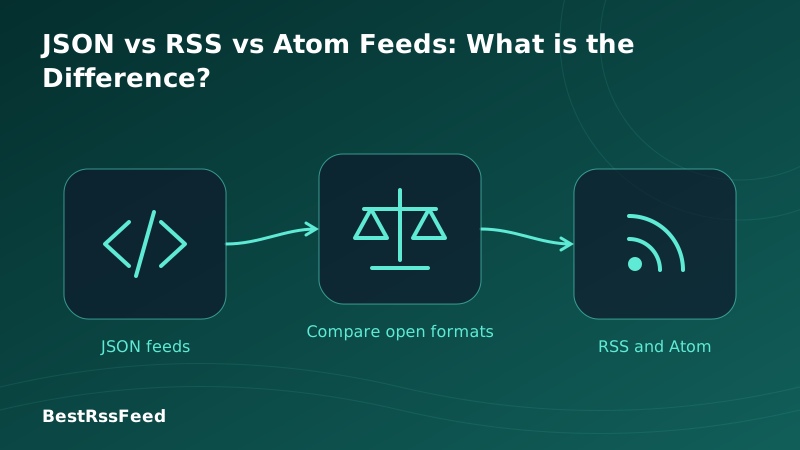
In the ecosystem of content syndication, three formats dominate the landscape: RSS , Atom , and JSON Feed . While they all serve the same fundamental purpose—delivering updated content to subscribers—they differ significantly in structure, performance, and use cases.
As we navigate 2026, the choice isn't just about technical preference; it's about reaching the right audience. Podcasters need RSS. JavaScript developers prefer JSON. Enterprise systems often rely on Atom. This guide provides a deep technical comparison to help you decide which format—or combination of formats—your project needs.
1. RSS (Really Simple Syndication)
RSS is the veteran of the group. Originally launched in 1999, RSS 2.0.1 remains the most widely supported feed format in the world. Its simplicity and longevity make it the default choice for blogs, news sites, and critically, podcasting.
Technical Specification
- Root Element:
<rss>with version attribute. - Channel: Contains metadata (title, link, description).
- Items: Individual entries wrapped in
<item>tags. - MIME Type:
application/rss+xml - Date Format: RFC 822 (e.g., "Mon, 01 Jan 2024 12:00:00 GMT").
<rss version="2.0">
  <channel>
    <title>My Blog</title>
    <link>https://example.com</link>
    <item>
      <title>Hello World</title>
      <link>https://example.com/post-1</link>
      <guid isPermaLink="true">https://example.com/post-1</guid>
      <pubDate>Mon, 01 Jan 2024 12:00:00 GMT</pubDate>
    </item>
  </channel>
</rss><description> for summaries, others for full content. Validators are essential to ensure compatibility across different readers.2. Atom Syndication Format
Created in 2005 as a response to RSS's ambiguities, Atom is an IETF standard (RFC 4287). It was designed to be strictly defined, extensible, and suitable for both content syndication and structured data exchange.
Technical Specification
- Root Element:
<feed>with XML namespace. - Entries: Wrapped in
<entry>tags. - IDs: Requires a unique
<id>for every entry (prevents duplication). - MIME Type:
application/atom+xml - Date Format: ISO 8601 (e.g., "2024-01-01T12:00:00Z").
<feed xmlns="http://www.w3.org/2005/Atom">
  <title>My Blog</title>
  <link href="https://example.com"/>
  <entry>
    <title>Hello World</title>
    <id>urn:uuid:1234</id>
    <updated>2024-01-01T12:00:00Z</updated>
    <link href="https://example.com/post-1"/>
  </entry>
</feed>
Atom's strictness is both its strength and weakness. It prevents common errors found in RSS feeds (like missing GUIDs causing duplicate posts), but it requires more verbose XML structures.
3. JSON Feed
The modern challenger. Introduced in 2017, JSON Feed was built for the JavaScript era. Since web browsers and Node.js environments natively understand JSON, this format eliminates the need for heavy XML parsing libraries.
Technical Specification
- Root Element: JSON Object.
- Items: Array of objects.
- Content: Supports both
content_textandcontent_html. - MIME Type:
application/feed+json - Date Format: ISO 8601.
{
  "version": "https://jsonfeed.org/version/1.1",
  "title": "My Blog",
  "home_page_url": "https://example.com",
  "items": [
    {
      "id": "1",
      "url": "https://example.com/post-1",
      "title": "Hello World",
      "date_published": "2024-01-01T12:00:00Z"
    }
  ]
}const data = await response.json(). Parsing RSS or Atom requires importing libraries like xml2js or fast-xml-parser, adding bundle size and complexity to your application.4. Comparative Analysis
To visualize the trade-offs, we've compiled data on adoption trends, parsing performance, and feature support across the three formats.
Adoption Trends (2021–2026)
While RSS remains dominant due to legacy support, JSON Feed is seeing exponential growth among modern web applications and static site generators.
Format Adoption Index
Parsing Performance & Complexity
Lower parsing time indicates better performance. Lower complexity score indicates easier implementation.
Parsing Metrics (Lower is Better)
Feature Radar
A multi-dimensional view of where each format excels. RSS wins on compatibility, JSON on speed.
Feature Capability Radar
5. Detailed Technical Comparison
Feed Structure Hierarchy
All three formats follow this logical structure, but implement it differently syntactically.
| Feature | RSS 2.0 | Atom 1.0 | JSON Feed |
|---|---|---|---|
| Syntax | XML | XML | JSON |
| Namespace Support | Yes (e.g., iTunes) | Yes (Extensible) | Limited |
| Unique Entry ID | Optional (<guid>) | Mandatory (<id>) | Mandatory (id) |
| File Size Overhead | High (Tags) | Highest (Namespaces) | Low (Key-Value) |
| Best Use Case | Podcasts, Legacy Blogs | Enterprise, Strict Data | Web Apps, JS Stack |
Platform Support Matrix
Support by Platform Type (%)
6. Implementation Strategy
In 2026, the best strategy is often polyglot syndication. Serving multiple formats ensures you cover all bases: legacy readers, podcast apps, and modern web clients.
- Primary: Generate RSS 2.0 for maximum compatibility (especially for podcasts).
- Secondary: Generate JSON Feed for your web app and JavaScript consumers.
- Discovery: Use
<link>tags in your HTML<head>to advertise both formats.
<head>
  <!-- Advertise RSS -->
  <link rel="alternate" type="application/rss+xml" title="RSS" href="/feed.xml">
  <!-- Advertise JSON -->
  <link rel="alternate" type="application/feed+json" title="JSON Feed" href="/feed.json">
</head>
Tools like BestRSSFeed can automate this process. Our RSS Builder allows you to create a source feed, and we can help distribute it in multiple formats depending on your audience's needs.
7. Frequently Asked Questions
8. The Verdict
There is no single "winner" in the battle of JSON vs RSS vs Atom. Each serves a specific niche in the content ecosystem.
- Choose RSS if you are publishing a podcast or need maximum legacy support.
- Choose Atom if you require strict validation and unique IDs for enterprise data.
- Choose JSON Feed if you are building a modern web application and want native JS parsing.
However, you don't have to choose just one. By leveraging tools like BestRSSFeed, you can maintain a single content source and syndicate it across all three formats, ensuring your content reaches every reader, regardless of their preferred technology stack.
Need help managing multiple feed formats?
BestRSSFeed simplifies feed creation, validation, and multi-format distribution.
Start Building Feeds