Why RSS Feeds Are Making a Comeback in the Age of AI
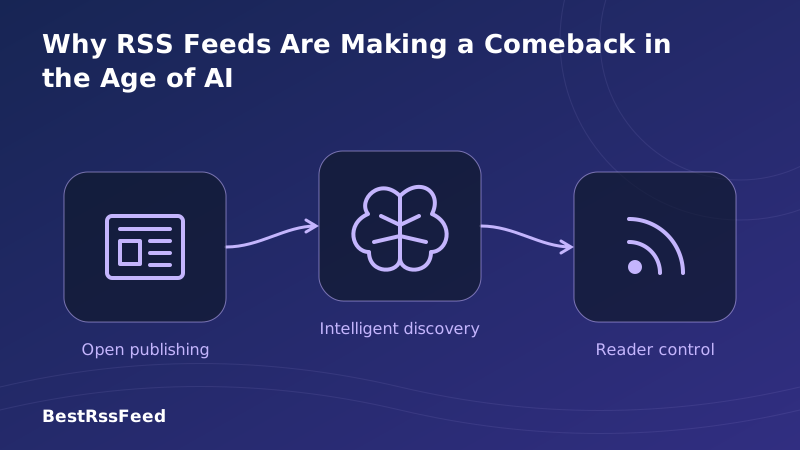
In 2026, a quiet revolution is reshaping how millions consume information online. As AI-generated content floods every platform and algorithmic feeds erode trust, a 25-year-old technology is making an unlikely comeback: RSS (Really Simple Syndication).
This isn't nostalgia. It's a rational response to a broken information ecosystem. RSS offers something no social platform can: content delivered on your terms, with no tracking, no algorithms, and no noise. Here's the full picture—from the raw numbers to the real-world workflows powering the RSS renaissance.
+42%
RSS user growth in 2026
54M+
Active RSS users worldwide
8.2M
Active RSS feeds tracked
1.4M+
New feeds created this year
1. The Numbers Don't Lie: RSS Usage Is Surging
According to aggregated data from major RSS reader platforms in 2026, global RSS readership has grown 42% year-over-year—the fastest pace in over a decade. The chart below tracks both active users (millions) and tracked feeds (millions) over the past six years.
RSS Growth Trajectory (2021–2026)
What's driving this? Three interconnected forces: the collapse of social media trust, the AI content deluge making curation critical, and a new generation of polished RSS apps that have made the technology genuinely frictionless.
Growth by Feed Category
Not all categories are growing equally. Newsletter-to-RSS bridges and podcast feeds are leading the surge, reflecting a broader "owned media" movement where creators and audiences alike prefer direct relationships over platform dependency.
Year-over-Year Feed Growth by Category (2026)
2. A Brief History of RSS: From Netscape to Now
To understand why RSS is resurging, it helps to understand why it never truly died. The technology has survived industry disruption, Google's attempted monopolisation, and the social media era—because it is built on an open standard that no single company controls.
RSS 0.9 released by Netscape
RSS 2.0 spec finalized by Dave Winer
Google Reader launches; RSS goes mainstream
Google Reader shuts down; community decentralises
Privacy laws (GDPR) spark RSS interest
Twitter/X chaos triggers mass RSS migration
AI content flood accelerates RSS renaissance
54M+ active users; fastest growth in a decade
The Twitter/X chaos of 2022–2023 was a second inflection point. Hundreds of journalists, developers, and researchers who had relied on Twitter for real-time information discovered that RSS offered similar signal without platform risk. Feedly reported a 67% spike in new signups during the three weeks following Twitter's API pricing changes in early 2023.
3. Trust Crisis: Why People Are Leaving Algorithmic Feeds
A 2026 Reuters Institute Digital News Report found that trust in social-media-curated news hit an all-time low of 29%. Meanwhile, 72% of respondents said they trust content they actively subscribe to via RSS or direct feeds. The bar chart below compares trust levels across platforms.
Platform Trust Index (2026)
Subscriber Retention: RSS vs. Social vs. Email
Trust also translates directly into retention. Once someone builds an RSS reading habit, they tend to keep it. RSS readers retain 69% of subscribers after 12 months, compared to 24% for social media follows and 27% for email lists.
Subscriber Retention Over 12 Months (%)
4. AI Content Explosion Fuels the RSS Renaissance
As AI-generated articles surged from 8% to an estimated 52% of all new online content throughout 2026, users increasingly sought curated, human-verified sources—exactly what a well-maintained RSS subscription list provides.
AI Content vs. RSS Adoption in 2026 (Indexed)
The correlation is clear: as the web becomes noisier, RSS offers a signal-to-noise ratio that algorithmic platforms simply cannot match. When you subscribe to a feed, you're subscribing to a source—not a topic as interpreted by an algorithm. The difference is enormous in practice.
5. How People Discover Content in 2026
RSS and aggregator-based discovery now account for 18% of all content discovery—up from just 9% three years ago. This makes it the fastest-growing discovery channel, outpacing both search and social in growth rate.
Content Discovery Channels (2026)
Time Spent vs. Information Quality
RSS users spend fewer hours consuming content yet report higher satisfaction. The following chart shows average weekly hours spent per medium—a reminder that RSS isn't about more consumption, it's about better consumption.
Avg. Weekly Hours Spent per Content Channel
6. Who Is Using RSS in 2026?
The stereotype of the RSS user as a neckbeard developer is outdated. Today's RSS audience spans knowledge workers, academics, journalists, investors, and an increasingly large cohort of everyday readers who have simply grown tired of social media.
RSS User Demographics by Profession (2026)
Global Geography of the RSS Comeback
While North America and Europe have the largest absolute user bases, growth is fastest in emerging markets. Africa & Middle East is leading with 88% YoY growth, driven by mobile-first RSS apps and the collapse of Twitter's free API.
| Region | Active Users (M) | YoY Growth |
|---|---|---|
| North America | 18.2M | +37% |
| Europe | 16.4M | +44% |
| Asia-Pacific | 12.8M | +61% |
| Latin America | 4.1M | +72% |
| Africa & ME | 2.5M | +88% |
7. RSS vs. Social Media vs. Email: Full Comparison
To understand why power users and knowledge workers prefer RSS, let's compare key features across the three major content delivery channels.
| Feature | RSS | Social | |
|---|---|---|---|
| No algorithmic filtering | ✅ | ❌ | ⚠️ |
| Zero tracking / ads | ✅ | ❌ | ❌ |
| Chronological timeline | ✅ | ❌ | ✅ |
| Works offline | ✅ | ❌ | ⚠️ |
| Own your subscription list | ✅ | ❌ | ⚠️ |
| Open standard (no lock-in) | ✅ | ❌ | ❌ |
Multi-Dimensional Platform Comparison
The radar chart below scores RSS, social media, and email across six dimensions that matter most to information-quality-focused readers: Privacy, Control, Speed, Discovery, Reliability, and Portability.
RSS vs. Social vs. Email — 6-Dimension Radar
8. The 2026 RSS Reader Landscape
Competition among RSS readers is intensifying. Modern RSS readers are no longer bare-bones feed lists—they include AI summarisation, keyword alerts, cross-device sync, and embeddable content widgets. Here's a snapshot of the leading platforms.
| Reader | Monthly Active Users | YoY Growth | Pricing | AI Features | Mobile App | Offline |
|---|---|---|---|---|---|---|
| Feedly | 16M | +22% | Free / $8/mo | ✅ | ✅ | ⚠️ |
| Inoreader | 4.2M | +38% | Free / $6/mo | ✅ | ✅ | ✅ |
| NewsBlur | 1.1M | +15% | $36/yr | ❌ | ✅ | ✅ |
| Miniflux | 320K | +61% | Self-hosted | ❌ | ❌ | ✅ |
| BestRSSFeed | Growing | New | Free / Pro | ✅ | ✅ | ✅ |
9. Privacy & Data Ownership: RSS's Hidden Superpower
Unlike social platforms that monetize attention through surveillance, RSS is fundamentally privacy-first. There's no tracking pixel, no behavioral profiling, and no ad auction deciding what you see. In a post-GDPR, post-cookie world, RSS aligns perfectly with the growing demand for data sovereignty.
0 cookies
No tracking by design
100%
User-curated, not algo-curated
Zero
No personal data required to subscribe
How RSS Works
No middleman. No algorithm. No tracking. Just content, delivered directly.
OPML: Your Feed List Is Portable Forever
RSS uses a standard called OPML (Outline Processor Markup Language) to export and import subscription lists. Unlike a Twitter following list or an Instagram account, your RSS subscriptions are a plain XML file you own. Switch readers in minutes. No proprietary lock-in. No data hostage situation.
- Sell your reading history to advertisers
- Show you content you didn't ask for
- Rate-limit access to content you subscribed to
- Disappear when a company pivots or goes bankrupt
- Require an account, phone number, or email address
10. Real-World Use Cases: Who Benefits Most?
RSS is not a one-size-fits-all tool, but its versatility is precisely its strength. Below are the six most common power-user profiles in 2026.
Track GitHub release notes, Hacker News, Stack Overflow feeds, and changelogs from dozens of libraries—all in one chronological inbox.
Subscribe to arXiv categories, journal TOC feeds, and think-tank blogs. Never miss a paper in your niche. Export OPML and share with colleagues.
Monitor competitors, government press releases, and breaking beat sources without being slaved to a Twitter/X doomscroll. Build source lists in minutes.
Follow SEC EDGAR filings, earnings call transcripts, and analyst blogs via RSS. Get signals before mainstream media covers them.
Replace your noisy social feed with a calm, ad-free reading experience curated by you—not an algorithm optimised to make you angry.
Every podcast is an RSS feed. Advanced RSS readers let you listen and read in one app, sync progress, and discover new shows without a walled garden.
11. How to Get Started with RSS in 5 Minutes
The biggest barrier to RSS adoption is perceived complexity. In practice, you can have a fully functioning RSS inbox in under five minutes.
Pick a reader
Feedly and Inoreader are the best free starters. If you value privacy, try NetNewsWire (open source, free) or Miniflux (self-hosted).
Add your first feeds
Visit any blog, news site, or podcast and look for the RSS icon (🔶). Paste the URL into your reader—it will auto-detect the feed. Most sites publish feeds at /feed or /rss.
Import an OPML starter pack
BestRSSFeed provides curated OPML bundles by topic (Tech, Finance, Science, News). Import one in a single click to have 30+ quality feeds instantly.
Set up keyword alerts
In Feedly or Inoreader, create rules to highlight or notify you when specific words appear across all your feeds. Useful for tracking competitors, topics, or names.
Refine over time
Unlike social algorithms that improve without your input, RSS improves because of your input. Prune feeds that stop delivering value. Add new ones as you discover great sources.
12. How BestRSSFeed Supercharges RSS for 2026
At BestRSSFeed, we built RSS Feed Flow to solve the friction points that held RSS back for years:
- One-click feed discovery — paste any URL and we auto-detect every available feed.
- Smart bundles — combine multiple feeds into a single unified stream.
- Custom alerts — get notified when specific keywords appear across your feeds.
- Embeddable widgets — display live RSS content on your own site, no code required.
- RSS Builder — create custom RSS feeds from any webpage, even sites without native RSS.
- Newsletter-to-RSS bridge — turn any email newsletter into a subscribable RSS feed without giving away your email.
- AI Digest — get a weekly AI-generated summary of your feeds, highlighting what actually matters.
- OPML Import/Export — move your entire subscription list in or out with a single click.
13. Frequently Asked Questions
14. The Verdict: RSS Is the Antidote to AI Noise
The data is unequivocal. In 2026, RSS isn't a relic—it's a strategic advantage. As AI floods the web with synthetic content, RSS gives you a direct, unfiltered line to the sources you trust. No algorithm stands between you and your information.
The numbers back this up: 54M active users, 42% year-over-year growth, 69% 12-month retention, and a trust score that puts every social platform to shame. The technology that Netscape shipped in 1999 is, in many ways, the most modern approach to information consumption available in 2026.
Whether you're a researcher, journalist, developer, or simply someone who values their attention, RSS Feed Flow by BestRSSFeed makes the comeback easy. Subscribe to exactly what matters. Ignore the rest.
Ready to take back control of your feed?
Join thousands of users who switched to RSS Feed Flow by BestRSSFeed in 2026.
Get Started Free