Why RSS Is the Best Alternative to Tracking-Based Platforms
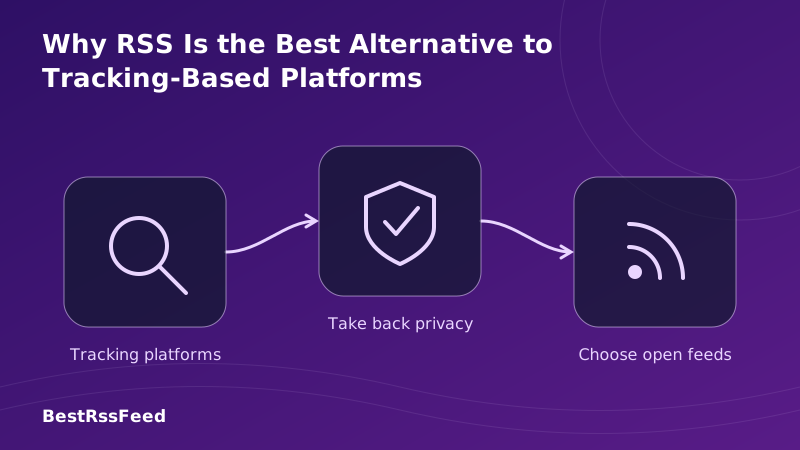
In 2026, the social contract of the web is being rewritten. Users are increasingly aware that "free" platforms extract payment in the form of personal data, behavioral surveillance, and attention exploitation.
For publishers, creators, and developers seeking sustainable, ethical ways to distribute content, RSS (Really Simple Syndication)isn't just a nostalgia play—it's the most robust, compliant, and user-respecting alternative to tracking-based platforms available today.
1. The Privacy Crisis: Why Tracking Platforms Are Failing Users
Modern tracking-based platforms operate on a fundamental asymmetry: users receive "free" content while platforms harvest, profile, and monetize their behavior. In 2026, this model faces unprecedented scrutiny:
- Regulatory pressure: GDPR fines exceeded €2.4B in 2025; CCPA, CPRA, and emerging global laws raise compliance costs.
- User backlash: 73% of consumers say they're "very concerned" about how companies use their data (Pew Research, 2026).
- Technical friction: Cookie deprecation, ITP, and browser privacy features break tracking infrastructure.
- Trust erosion: Only 29% of users trust social media as a news source (Reuters Institute).
Privacy Score vs. Tracking Intensity by Platform (2026)
RSS achieves near-perfect privacy scores because it was designed before the surveillance economy existed. No authentication. No cookies. No behavioral logging. Just content, delivered.
2. How RSS Eliminates Tracking by Design
RSS isn't "privacy-enhanced"—it's privacy-native. Its architecture makes surveillance technically impossible without breaking the protocol.
Privacy Architecture: RSS vs. Tracking Platforms
RSS eliminates the surveillance layer entirely—content flows directly from publisher to reader.
Technical Privacy Guarantees
| Data Point | RSS | Social Media | |
|---|---|---|---|
| Reading History | Never collected | Always tracked | Often tracked |
| Device Fingerprint | Impossible | Standard practice | Common |
| Location Data | Never collected | Precise GPS | IP-based |
| Behavioral Profiling | None | Extensive | Moderate |
| Ad Targeting | Zero | Core business model | Frequent |
| Data Selling | Never | Routine | Sometimes |
3. Compliance by Default: RSS & Global Privacy Laws
For publishers, regulatory compliance is a major operational cost. RSS dramatically reduces this burden because it collects no personal data by default.
GDPR/CCPA Compliance Cost Comparison (2026)
The cost differential is staggering. An RSS-based distribution system requires minimal legal overhead because there's no personal data to protect. For startups and independent creators, this levels the playing field against well-funded surveillance platforms.
Key Compliance Advantages
- No consent management: No cookie banners, no preference centers, no consent logs to maintain.
- No data subject requests: Since you don't collect subscriber identities, there's nothing to retrieve or delete.
- No breach liability: No stored personal data means no risk of fines from subscriber data leaks.
- Cross-border simplicity: RSS works identically in the EU, US, Asia—no regional compliance forks needed.
4. User Trust & Retention: The Privacy Dividend
Privacy isn't just ethical—it's good business. Users who feel respected stay longer, engage more deeply, and advocate more passionately.
Trust & Satisfaction vs. Tracking Level
The correlation is clear: as tracking intensity increases, both trust and satisfaction plummet. RSS occupies the optimal quadrant—high trust, high satisfaction, zero tracking.
Retention: Privacy-First vs. Tracking-Based
Subscriber Retention Over 12 Months (%)
5. The Migration Trend: Users Are Voting With Their Feeds
Data shows a clear migration pattern: as privacy awareness grows, users increasingly seek RSS alternatives to tracking platforms.
Privacy Awareness & RSS Migration Trends
In 2026, 58% of internet users actively consider privacy when choosing content platforms—a 4.8x increase since 2022. RSS adoption is the fastest-growing response to this shift.
6. Feature Comparison: RSS vs. Tracking Platforms
Beyond privacy, RSS offers practical advantages that tracking platforms struggle to match. The table below compares core capabilities.
| Feature | RSS | Social Media | |
|---|---|---|---|
| User owns subscription list | partial | ||
| No account required | |||
| Portable data (OPML) | partial | ||
| Zero third-party cookies | partial | ||
| No behavioral profiling | |||
| Works offline | partial | ||
| Chronological by default | |||
| No algorithmic filtering | |||
| Open standard (no lock-in) |
Multi-Dimensional Platform Assessment
RSS vs. Tracking Platforms — 6-Dimension Radar
RSS dominates on dimensions that matter most to privacy-conscious users and compliance-focused publishers. Tracking platforms lead only on "Discovery"—a metric that often comes at the cost of user autonomy.
7. Monetization Without Surveillance: The RSS Model
A common misconception: "If I don't track users, I can't monetize." RSS proves otherwise. Here are proven, privacy-respecting revenue models:
Direct Subscriptions
Link to paid content behind a paywall. RSS delivers the headline and excerpt; the full article requires authentication.
Contextual Sponsorships
Include sponsor messages within feed items (clearly labeled). No behavioral targeting needed—relevance comes from content context.
Affiliate Links
Embed affiliate links in feed content. Earn commissions when readers purchase—no tracking required beyond the merchant's own system.
Premium RSS Tiers
Offer enhanced feeds (full content, early access) via authenticated RSS endpoints. Users pay for value, not for being profiled.
8. How to Migrate Your Audience to RSS
Transitioning from tracking platforms to RSS requires strategy. Here's a phased approach that minimizes disruption while building trust.
Migration Pathway: From Tracking to RSS
A phased approach minimizes disruption while building trust with privacy-conscious users.
Practical Implementation Steps
- Audit your tracking dependencies: Map every analytics script, ad network, and social widget on your site. Identify which can be replaced with privacy-respecting alternatives.
- Implement parallel distribution: Keep existing channels while prominently promoting RSS subscription. Add RSS icons to navigation, article footers, and CTAs.
- Educate your audience: Create content explaining RSS benefits: "Read our articles without being tracked," "Own your subscription list," "No algorithm decides what you see."
- Provide migration tools: Offer OPML export for users leaving other platforms. BestRSSFeed provides one-click OPML generation for any site.
- Measure privacy-respecting metrics: Track aggregate feed fetches, content popularity, and geographic distribution—without storing personal data.
<!-- Add RSS subscription CTA to your site -->
<div class="rss-cta">
  <h3>Read without being tracked</h3>
  <p>Subscribe to our RSS feed for ad-free, algorithm-free content delivery.</p>
  <a href="/feed.xml" class="btn-rss">
    <Rss className="w-4 h-4" /> Subscribe via RSS
  </a>
  <p class="text-xs text-muted-foreground mt-2">
    No account required. No cookies. No tracking.
  </p>
</div>
9. The Future: Privacy-First Content Ecosystems
In 2026, the trajectory is clear: privacy regulations will tighten, browser restrictions will expand, and user expectations will shift. RSS isn't just surviving this transition—it's positioned to thrive.
Emerging RSS Innovations
- Authenticated RSS: Secure endpoints for premium content without compromising subscriber privacy.
- WebSub (PubSubHubbub): Real-time feed updates via webhooks—no polling needed.
- JSON Feed + RSS hybrid: Modern parsers handle both formats seamlessly.
- Privacy-preserving analytics: Aggregate metrics using differential privacy techniques.
- Decentralized discovery: ActivityPub and IndieWeb protocols extending RSS's reach.
The Privacy Tipping Point
Industry analysts predict that by 2028, privacy-first distribution will be a competitive requirement, not a niche preference. Publishers who adopt RSS now gain first-mover advantage in building trust-based audiences.
10. Frequently Asked Questions
11. The Verdict: RSS Is the Ethical Infrastructure for Content
In an era of surveillance capitalism, RSS stands as a testament to what the web could be: open, respectful, and user-centric. It's not a relic—it's a blueprint for sustainable, ethical content distribution in 2026 and beyond.
For publishers: RSS reduces compliance costs, builds user trust, and future-proofs your distribution against regulatory shifts. For users: RSS returns control, eliminates noise, and protects your digital dignity.
The choice isn't between "free tracking" and "paid privacy." It's between extraction and respect. RSS chooses respect—and in 2026, that's the only choice that scales.
Build Privacy-First Distribution
BestRSSFeed provides tools to create, manage, and embed RSS feeds—without compromising user privacy.
Start Free Trial