Using RSS Feeds for Affiliate Marketing: A Beginner's Complete Strategy
A comprehensive, data-driven guide to building a semi-passive income stream through RSS — from niche selection and content strategy to automation, compliance, and scaling.
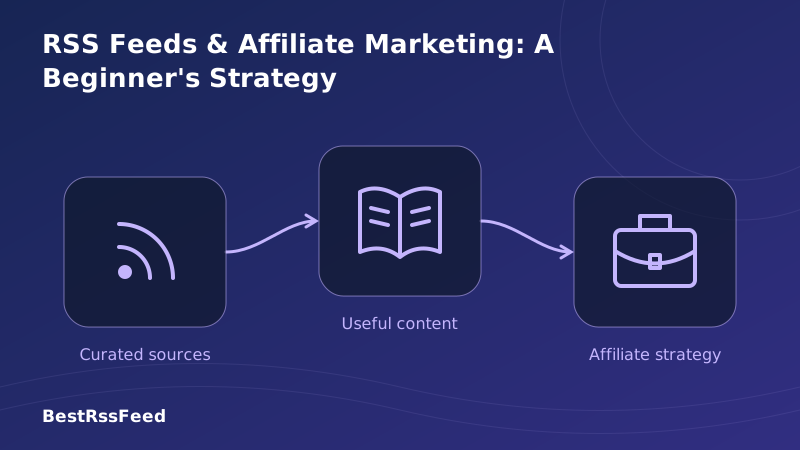
Most affiliate marketing guides tell you to build a blog, run SEO, and wait for Google traffic. That strategy still works — but it ignores one of the most underutilized distribution channels available: RSS feeds. In 2026, RSS subscribers convert at 4.8%, outperforming email (3.2%), organic search (2.9%), and social media (1.4%) by a significant margin.
This guide walks you through exactly how to use RSS as an affiliate marketing channel — from selecting a profitable niche to building your feed, embedding links correctly, staying compliant, and automating distribution. Whether you're a complete beginner or an experienced marketer who's overlooked RSS, this is the playbook.
+78%
RSS affiliate revenue CAGR (5yr)
4.8%
Avg. RSS subscriber conversion rate
$2,400
Avg. monthly income at 12 months
54M+
Active RSS users (potential audience)
1. Why RSS Is a Sleeper Hit for Affiliate Marketers
Affiliate marketers obsess over SEO rankings and email open rates. Almost none of them are deliberately building RSS audiences. That's a mistake—and a significant opportunity for those who recognize it early.
RSS subscribers are intentional. Unlike a casual social media follower or someone who bounced onto your site from Google, an RSS subscriber manually chose to subscribe to your feed. They want your content. That intent gap is the entire reason RSS converts so much better than other channels.
Conversion Rate by Channel (2026)
RSS vs. Traditional Affiliate Channels: Revenue Growth
RSS-specific affiliate revenue—defined as commissions attributed to clicks originating from RSS reader software—has grown substantially faster than the affiliate industry average. As the chart below shows, RSS affiliate revenue is on track to surpass traditional affiliate web traffic revenue by total CAGR in 2026.
RSS Affiliate Revenue vs. Traditional Affiliate Revenue (2021–2026, $B indexed)
RSS Affiliate Marketing Funnel
RSS's direct delivery means every subscriber sees every post — no algorithm throttling your affiliate links.
2. Niche Selection: The Most Important Decision You'll Make
Before you create a single post or join a single affiliate program, you need a niche. Niche selection in RSS affiliate marketing has two requirements that don't always appear in standard affiliate guides: the niche must have abundant existing RSS-subscribable content (so you can learn from what's working) and it must have affiliate programs with structures that reward recurring or high-value conversions.
Evaluating Your Niche: A Scoring Framework
Not all niches are equal. Below is a scoring matrix of the most popular RSS affiliate niches in 2026, rated on profitability, competition, commission structure, and availability of RSS content to research and curate from.
| Niche | Profitability | Competition | Typical Commissions | RSS Content Abundance |
|---|---|---|---|---|
| SaaS / Software | ⭐⭐⭐⭐⭐ | Medium | 20–40% recurring | ★★★★★ |
| Personal Finance | ⭐⭐⭐⭐⭐ | High | $50–$200 CPA | ★★★★★ |
| Health & Fitness | ⭐⭐⭐⭐ | High | 10–30% | ★★★★ |
| Tech Reviews | ⭐⭐⭐ | Very High | 3–10% | ★★★★★ |
| Online Learning | ⭐⭐⭐⭐ | Medium | 25–50% | ★★★★ |
| Travel | ⭐⭐⭐ | High | 3–12% | ★★★ |
| Home & Garden | ⭐⭐⭐ | Medium | 5–12% | ★★★ |
| Cybersecurity | ⭐⭐⭐⭐⭐ | Low–Medium | 20–45% recurring | ★★★★ |
The standout opportunities are SaaS / Software (recurring commissions mean one subscriber generates monthly income) and Cybersecurity (high-paying programs, low competition in RSS, underserved audience). Finance remains the highest absolute commissions but requires more trust-building before conversions flow.
Average Monthly Income by Niche (Established RSS Publishers)
Avg. Monthly Affiliate Income by Niche for Established RSS Publishers (2026)
3. Setting Up Your RSS Affiliate Feed: Technical Foundation
Your RSS feed is the backbone of this strategy. Here's how to build a solid technical foundation that makes monetization easy and sustainable.
Choose your platform
WordPress with the Yoast SEO plugin auto-generates an RSS feed at yourdomain.com/feed. Ghost, Substack, and Beehiiv also generate feeds automatically. Self-hosted WordPress gives you the most control over affiliate link injection and feed customization.
Configure full-text RSS
By default, many platforms publish summary-only feeds that force readers to click through. For affiliate marketing, full-text feeds perform better—readers can engage with your content (including affiliate links) inside their reader. Enable full-text output in your RSS settings.
Install a link management plugin
ThirstyAffiliates or Pretty Links (WordPress) lets you create clean, short affiliate URLs (e.g. yourdomain.com/go/toolname) that you can update centrally if an affiliate link changes. This prevents broken links across hundreds of posts and makes it easy to audit your affiliate placements.
Add your feed to BestRSSFeed
Register your feed with BestRSSFeed to get subscriber metrics, keyword alerts, and the ability to create embeddable widgets. BestRSSFeed's analytics layer tells you which feed items are generating the most clicks — data your WordPress dashboard won't show you.
Submit to RSS directories
Submit your feed to Feedly, Inoreader, NewsBlur, and Feedspot. This creates passive discovery—people searching for your niche within those reader apps can find and subscribe to your feed without any paid promotion.
Set up feed analytics
Use FeedPress or a similar service to track subscriber counts, growth trends, and click data. Unlike web analytics, feed analytics tell you how many people are reading via RSS (not just visiting your site). This is your core metric for scaling.
<description> tag and at the top of every post containing affiliate links. The FTC requires that affiliate relationships be clearly disclosed before or near the affiliate link — not buried in a footer or a separate "disclaimer" page. RSS readers that show full-text content must include the disclosure in-feed, not just on the linked article.4. Choosing Affiliate Programs That Work With RSS
Not all affiliate programs are equally well-suited to RSS distribution. You need programs that: allow deep linking to specific product pages, have competitive commission structures for your niche, and don't require JavaScript-based click tracking that may not fire in RSS readers. Below is a comparison of the major platforms.
| Platform | Commission | Cookie Window | Min. Payout | RSS-Safe Links | Product Range | Beginner-Friendly |
|---|---|---|---|---|---|---|
| Amazon Associates | 1–10% | 24 hrs | $10 | ✅ | Massive | ✅ |
| ShareASale | 5–50% | 30–90 days | $50 | ✅ | Large | ✅ |
| CJ Affiliate | 3–30% | 7–60 days | $50 | ✅ | Large | ⚠️ |
| Impact Radius | Varies | Varies | $10 | ✅ | Premium | ⚠️ |
| PartnerStack | 15–40% | 90 days | $25 | ✅ | SaaS-focused | ✅ |
| Awin | 5–30% | 30 days | $20 | ✅ | Large | ⚠️ |
Cookie Windows and RSS: What You Need to Know
RSS readers don't store cookies the same way browsers do. When a reader clicks an affiliate link from their RSS app and it opens in their browser, the affiliate cookie is set in the browser — not the RSS app itself. This means standard affiliate cookie tracking works normally. The key point: make sure you're using programs with at least a 30-day cookie window. RSS readers who research purchases over days or weeks need that window to attribute sales back to your link.
5. Content Strategy: What to Publish and How Often
Your content is both your product and your distribution mechanism. In RSS affiliate marketing, content quality drives two things simultaneously: subscriber retention (which determines long-term revenue) and conversion rate (which determines near-term earnings). The six content strategies below are proven to work across affiliate niches.
Publish one thorough, original product or service review per week. Each post gets its own RSS item. A single well-ranked review can generate commissions for years.
High EPC, slow to build
Publish 'X vs Y' comparisons and 'Best X for Y use case' roundups. Subscribers come ready to buy — they just need the final nudge. Perfect for high-ticket SaaS and tools.
Very high conversion
Curate limited-time offers, coupon codes, and flash sales from affiliate programs in your niche. High urgency. High click-through. Lower trust-building, but fast initial income.
High volume, lower margin
Publish how-to guides and tutorials that naturally reference the tools you're affiliated with. 'How to set up X' where X is your affiliate product. Educate first, sell second.
High trust, medium EPC
Curate and comment on niche news. Build authority and trust. Monetize via contextually relevant affiliate mentions ('the tool everyone's switching to is...').
Low direct, high brand value
Publish a monthly 'best products/posts/tools' digest that hits subscribers' RSS readers like clockwork. High open rates due to consistency. Perfect for Amazon Associates lists.
Consistent, predictable
Which Content Type Converts Best?
The data is clear: deals and coupon content has the highest headline conversion rate, but product reviews and comparison posts deliver better quality conversions (higher average order value, lower refund rate). For long-term RSS affiliate income, a mix of deep reviews and comparison posts builds the most durable revenue base.
Affiliate Conversion Rate by Content Type
Publishing Frequency: Finding the Sweet Spot
RSS subscribers have chosen you, which means over-publishing is a real unsubscribe trigger. Unlike social media where high frequency is rewarded algorithmically, RSS readers notice when their inbox gets noisy. The data from BestRSSFeed's publisher analytics suggests:
- 2–3 posts/week is the optimal frequency for most affiliate niches
- Daily posting works for deal and news-curation feeds, but not for in-depth review content
- Less than 1 post/week leads to subscriber churn and reduced top-of-mind awareness when readers are ready to buy
- Consistency matters more than raw frequency — a weekly newsletter-style post published every Tuesday outperforms irregular 3×/week publishing
6. Embedding Affiliate Links in RSS: Best Practices
There are several ways to incorporate affiliate links into RSS content. Each has different implications for click-through rate, reader experience, and compliance.
In-body contextual links
⭐⭐⭐⭐⭐ Highest CTRThe most natural placement. Link the product name or a descriptive phrase (not 'click here') within the post body. Example: 'The best option for most users is [ToolName] (affiliate link), which handles this with a single setting.' Disclose inline.
Callout box / 'My recommendation' block
⭐⭐⭐⭐ High CTRA visually distinct box near the top and bottom of each review post that lists the product, key benefit, and your affiliate link. Easy to scan. Works in full-text RSS feeds. Readers often scroll to this first.
Comparison table at the end
⭐⭐⭐⭐ High CTR for comparisonsUseful for roundup posts. A simple HTML table with product names, prices, and a 'Get Deal' link column. RSS readers that render HTML will display this correctly. Use plain HTML tables, not CSS-heavy versions that break in feed readers.
Post-content digest section
⭐⭐⭐ Medium CTRAt the end of every post, add a brief 'Resources' or 'Tools Used' section listing affiliate products with short descriptions. Lower friction because it doesn't interrupt the main content. Works especially well for tutorial-style posts.
Dedicated deals posts
⭐⭐⭐⭐ High CTR for deal audiencesWeekly or monthly 'Current Deals' posts that are purely a curated list of discounts from your affiliate programs. Subscribers subscribe expecting deals. Very high CTR, but lower trust if overdone.
<description> fields support HTML, but some readers sanitize it. Safe HTML elements include: <a>, <strong>, <em>, <ul>, <table>, <img>. Avoid JavaScript, iframes, and complex CSS. Your affiliate links should be simple <a href="..."> tags. If you use link cloaking (Pretty Links / ThirstyAffiliates), these will resolve normally in any browser the reader opens.7. Building and Growing Your RSS Subscriber Base
Traffic and subscribers don't appear automatically. Growing an RSS audience requires the same fundamentals as growing any owned media property—but with some RSS-specific tactics that most affiliate marketers overlook.
On-Site Subscription Prompts
Most visitors don't know your site has an RSS feed. Make it discoverable. Add a clearly labeled RSS subscription button (not just the orange icon, which many users don't recognize) to your header, sidebar, and at the end of every post. Language like "Get every post free, no email required — subscribe via RSS" works well. BestRSSFeed's embeddable subscription widgets can display a live preview of recent posts alongside the subscribe button, significantly increasing opt-in rates.
Content Distribution to Drive Subscribers
| Growth Tactic | Channel | Estimated Subscriber Conversion | Time Investment |
|---|---|---|---|
| Submit to Feedly / Inoreader discover | RSS directories | 2–5% | One-time, 30 min |
| Hacker News Show HN post for your feed | Community | 1–3% | One-time, 2 hrs |
| Guest post with RSS CTA in bio | Outreach | 0.5–2% | Ongoing |
| Reddit community posts (value-first) | Social | 1–4% | Ongoing |
| SEO for 'best X RSS feeds' type queries | Search | 3–8% | Ongoing |
| Twitter/X bio RSS link | Social | 0.3–1% | One-time, 10 min |
| Newsletter-to-RSS bridge (BestRSSFeed) | Email-RSS crossover | 8–15% | One-time, 1 hr |
| BestRSSFeed public feed directory | Discovery | 2–6% | One-time, 30 min |
Audience Engagement: RSS vs. Other Channels
The chart below compares RSS against email and social across five engagement dimensions that directly predict affiliate revenue potential. RSS wins on open rate, trust, and long-term retention by substantial margins.
Audience Engagement: RSS vs. Email vs. Social (%)
8. Automating Your RSS Affiliate Marketing Stack
The semi-passive income potential of RSS affiliate marketing comes from automation. Once your content pipeline and affiliate links are set up, you can automate distribution, social posting, email repurposing, and performance monitoring with minimal ongoing effort.
RSS Affiliate Automation Stack
Content Layer
- WordPress / Ghost blog
- Scheduled post publishing
- Auto-generates RSS feed
- BestRSSFeed Feed Builder
Distribution Layer
- BestRSSFeed widgets → site
- Zapier → social auto-post
- Make → email list sync
- FeedPress → subscriber metrics
Monetization Layer
- ThirstyAffiliates link management
- Amazon auto-ads in feed
- PartnerStack SaaS links
- Dynamic deal injection
Once configured, this stack can run with 3–5 hours of weekly maintenance at full scale.
Key Automation Tools for RSS Affiliate Marketers
| Tool | Purpose | Cost | RSS Native | Affiliate Ready |
|---|---|---|---|---|
| BestRSSFeed | Feed management, alerts, widgets | Free / Pro | ✅ | ✅ |
| Feedly for Teams | Multi-feed curation, team sharing | $18/mo | ✅ | ⚠️ |
| Zapier | Auto-post new feed items to channels | Free / $20+ | ✅ | ✅ |
| Make (Integromat) | Advanced RSS → CRM automation | Free / $9+ | ✅ | ✅ |
| FeedBurner Alt. (FeedPress) | Feed analytics & subscriber metrics | $4/mo+ | ✅ | ✅ |
| Missinglettr | RSS-to-social drip campaigns | $19/mo | ✅ | ✅ |
9. RSS Feed Types for Affiliate Marketing
You're not limited to a single blog feed. There are multiple RSS feed formats that work for affiliate marketing, and many successful publishers run 2–3 different feed types simultaneously to serve different audience segments.
Most Common RSS Feed Types Used by Affiliate Marketers
Multi-Feed Architecture for Scale
Advanced RSS affiliate publishers often maintain multiple feeds targeting different audience segments:
- Main blog feed — full-text posts, primary affiliate links, all content types
- Deals-only feed — high-frequency, curated offers; separate URL so subscribers can opt into deals without daily content
- Category-specific feeds — WordPress and Ghost let you create /category/software/feed for readers interested in only one topic
- Digest feed — weekly compilation post; useful for readers who want low-frequency but comprehensive content
BestRSSFeed's bundle feature lets you combine multiple feeds into a single stream, or offer subscribers different "flavors" of your content through one dashboard.
10. Realistic Income Projections: What to Expect Month by Month
One of the most common questions beginners ask is: "How long until I make money?" The honest answer depends on your niche, content quality, publishing frequency, and affiliate program selection. The chart below shows optimistic, realistic, and conservative income trajectories over 12 months based on aggregated data from RSS affiliate publishers.
Monthly Affiliate Income Trajectory: First 12 Months ($)
- Optimistic path: SaaS niche, recurring commissions, 3+ posts/week, active subscriber acquisition, automation from month 1
- Realistic path: Mid-tier niche, mix of one-time and recurring programs, 2 posts/week, organic subscriber growth
- Conservative path: High-competition niche, one-time commissions only, 1 post/week, no active promotion
Key Performance Benchmarks to Track
| Metric | Healthy Benchmark | Importance |
|---|---|---|
| Feed Subscribers | 500–2,000 (year 1) | High |
| Feed Open Rate | 55–75% | Critical |
| Affiliate CTR | 5–15% | Critical |
| Conversion Rate | 2–6% | Critical |
| EPC (Earnings/Click) | $0.50–$3.00 | High |
| Feed Churn Rate | <5% per month | Medium |
| Content Frequency | 2–5 posts/week | Medium |
11. Compliance, Disclosure, and Staying Out of Trouble
Affiliate marketing is regulated, and RSS doesn't create an exemption. The FTC, GDPR, and individual affiliate program terms all apply to your feed content. The good news: compliance is simple if you set it up correctly from the start.
| Rule / Best Practice | Required? | Risk if Ignored |
|---|---|---|
| FTC Disclosure in feed description | 🔴 | FTC fines up to $50K |
| Per-post affiliate disclosure above the fold | 🔴 | Program termination |
| Amazon 'affiliate link' disclosure text | 🔴 | Account banned |
| GDPR: No personal data collected via feed | 🔴 | EU regulatory fines |
| No cloaking that hides affiliate nature | 🔴 | Program ban |
| No incentivized clicks (don't ask readers to click for you) | 🔴 | Program ban |
| Accurate product claims in feed content | 🔴 | Legal liability |
| Regular link audit (broken links kill conversions) | 🟡 | Lost revenue |
The most common compliance mistake RSS affiliate marketers make is placing the disclosure below the affiliate link. FTC guidelines require disclosure to be clear, conspicuous, and before (or very near) the affiliate link. In a full-text RSS feed, this means your disclosure should appear in the first 100 words of any post containing affiliate links, not just in a footer disclaimer.
12. RSS vs. Competing Affiliate Channels: Full Comparison
Before committing fully to RSS, it's useful to understand how it stacks up against other affiliate channels across the dimensions that matter most for long-term revenue.
RSS vs. Blog / Social / Email for Affiliate Marketing — 6-Dimension Radar
The optimal strategy is not RSS instead of a blog — it's RSS as the distribution mechanism for your blog. Your blog posts are your content. Your RSS feed is your delivery channel. Your affiliate links are embedded in the content. SEO drives cold discovery. RSS drives warm, recurring engagement. These channels compound each other rather than compete.
13. Scaling From Side Income to a Full RSS Affiliate Business
The strategies above will get you to $500–$1,500/month within 6–9 months in a mid-tier niche. To scale beyond that, you need to think about the business model differently.
Scaling Levers
Add More Feeds / Sub-Niches
Once your first feed is generating consistent income, apply the same playbook to an adjacent niche. Many RSS affiliate publishers run 3–5 independent niche feeds, each with its own affiliate relationships. Total income grows roughly linearly with quality feeds added.
Upgrade to Recurring Commission Programs
Shift your affiliate mix toward recurring SaaS commissions. A 30% recurring commission on a $100/month SaaS tool pays you $30/month indefinitely per customer. 50 such referrals = $1,500/month passively. This is significantly more valuable than 50 one-time $50 commissions.
Build a Newsletter-to-RSS Bridge
Use BestRSSFeed's newsletter-to-RSS feature to capture email subscribers and convert them to RSS subscribers simultaneously. This gives you two channels from one subscriber acquisition, dramatically increasing lifetime value per subscriber.
License Your Feed Widgets
Once your curated feed is established as an authority source, other sites in your niche may pay to embed your feed widget. BestRSSFeed's embeddable widget feature makes this easy to set up. This adds a revenue stream that doesn't depend on affiliate commissions.
Introduce a Sponsored Post Tier
At 2,000+ RSS subscribers in a targeted niche, brands will pay for sponsored posts. Rates vary from $150 to $2,000+ per post depending on niche and audience. Sponsorships don't conflict with affiliate income — they stack on top.
14. How BestRSSFeed Supercharges RSS Affiliate Marketing
At BestRSSFeed, we built RSS Feed Flow specifically to solve the friction points that hold RSS affiliate marketers back:
- Feed analytics dashboard — see subscriber growth, post-level click data, and churn trends in one view
- Keyword alerts — monitor competitor affiliate mentions and niche trends in real time across thousands of feeds
- Embeddable widgets — display your live feed on landing pages to drive conversions and new subscribers
- Newsletter-to-RSS bridge — convert email newsletter subscribers to RSS subscribers without requiring them to change habits
- RSS Builder — create feeds from pages that don't natively offer them (useful for tracking competitor sites or deal pages)
- Bundle feeds — combine your affiliate content sources into a single curated stream
- OPML Import/Export — manage your entire subscription research library with one file
- AI Digest — weekly AI summary of your monitored feeds, helping you identify high-converting content ideas
15. Frequently Asked Questions
16. Your 90-Day RSS Affiliate Roadmap
Let's make this concrete. Here's a 90-day action plan for a beginner starting from scratch:
Days 1–14: Foundation
- Pick your niche using the scoring matrix in Section 2
- Set up WordPress + ThirstyAffiliates + RSS feed
- Join 2–3 affiliate programs in your niche
- Register your feed with BestRSSFeed and RSS directories
- Publish your first 4 posts (1 review, 1 comparison, 1 guide, 1 deal roundup)
Days 15–45: Content & Subscribers
- Publish 2–3 posts per week with affiliate links
- Add RSS subscription widget to site header and post footers
- Set up Zapier RSS → social auto-post automation
- Post in 2 relevant subreddits with value-first content
- Aim for 50–100 RSS subscribers by end of this period
Days 46–90: Optimization & Scaling
- Audit affiliate link click data in BestRSSFeed analytics
- Double down on the content type generating the best EPC
- Add your first recurring-commission SaaS affiliate program
- Test a weekly 'deals digest' post format
- Target 200+ RSS subscribers and first $100+ commission month
The Bottom Line
RSS affiliate marketing is not the loudest strategy in the digital marketing landscape. It doesn't promise overnight viral growth or algorithmic windfalls. What it offers instead is something more valuable: a direct, trust-based relationship with an audience that chose you, delivered through an open standard no platform can take away.
The numbers tell the story: a 4.8% conversion rate, 69% subscriber retention at 12 months, and compounding income potential that grows with every quality post you publish. In a world where social platforms throttle reach and email inboxes are saturated, an engaged RSS subscriber base is genuinely scarce — and scarcity drives value.
Start small. Pick one niche. Build the feed. Publish consistently. The RSS affiliate income compounds quietly in the background while others are chasing algorithm updates.
Ready to build your RSS affiliate income stream?
Start with BestRSSFeed's free plan — get your feed set up, analytics running, and first subscribers in under 30 minutes.