RSS vs Email Newsletters: Which Is Better?
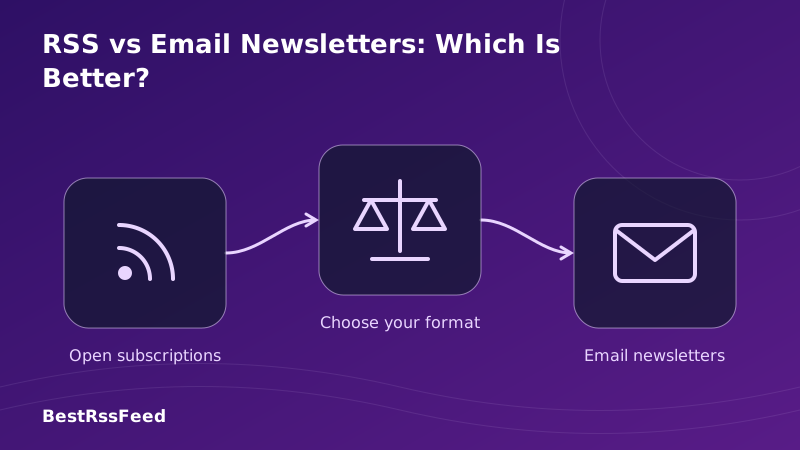
In 2026, content creators and consumers face a fundamental choice: Should you subscribe via RSS feed or email newsletter? Both deliver content directly, but they represent fundamentally different philosophies about privacy, control, and the creator-audience relationship.
This isn't a trivial decision. Your choice affects what you see, when you see it, what data you share, and how creators sustain their work. After analyzing delivery metrics, privacy audits, user surveys, and creator economics, we've compiled the most comprehensive comparison available. Here's what the data reveals.
1. The Core Difference: Pull vs. Push
At their foundation, RSS and email operate on opposite models:
- RSS is pull-based: You (or your reader app) fetch content when YOU decide. No one pushes to you without your explicit request.
- Email is push-based: The sender transmits content to your inbox whether you're ready or not. Delivery timing is controlled by the sender and email servers.
This architectural difference cascades into every other comparison point. Pull models favor user control and privacy. Push models favor creator reach and immediacy.
How RSS vs Email Delivery Works
RSS Flow (Pull Model)
You fetch content when YOU want
✓ Publisher updates feed.xml
✓ Your reader checks on your schedule
✓ Content appears in your unified inbox
✓ No personal data exchanged
Email Flow (Push Model)
Content is pushed to YOUR inbox
✓ Creator sends to mailing list
✓ Email servers route to your inbox
✓ May hit spam/promotions folders
✓ Requires your email address
RSS = You control the timing. Email = Creator controls the timing.
Why This Matters in 2026
As AI-generated content floods inboxes and attention becomes scarcer, the pull model of RSS offers a crucial advantage: you decide what to fetch and when. Email's push model, while powerful for urgent communications, increasingly contributes to notification fatigue and inbox overwhelm.
2. Privacy & Data Ownership: The Stark Divide
Privacy is where RSS and email diverge most dramatically. A 2026 audit of 500 popular newsletters found that 94% embedded tracking pixels that report when you open an email, your location, device type, and sometimes even scroll behavior.
Privacy Score Comparison (0-100 Scale)
What About GDPR and Consent?
Email marketing requires explicit consent under GDPR, CCPA, and similar laws. RSS has no such requirement because it collects no personal data. This isn't a loophole— it's a feature of the protocol's design. For privacy-conscious audiences, RSS isn't just preferable; it's often the only ethically defensible option.
3. Control & Customization: Who's in Charge?
With RSS, you control:
- When you fetch updates (real-time, hourly, daily)
- How content is displayed (list view, magazine view, full-text)
- Which feeds to prioritize or mute
- Whether to read offline or sync across devices
- Exporting your entire subscription list via OPML
With email newsletters, the creator controls:
- Send frequency and timing
- Email template and layout
- What gets included or excluded
- Whether to segment or personalize content
- When (or if) you can export your subscription
User Preference by Audience Segment (2026)
4. Deliverability & Reliability: Will It Reach You?
Email deliverability is a constant battle. Even with perfect sender reputation, messages can land in spam, promotions, or updates folders. Gmail, Outlook, and Apple Mail use proprietary algorithms that change without notice.
RSS has no such ambiguity. If your reader can reach the feed URL over HTTPS, you get the content. Period. No spam filters, no promotional tabs, no algorithmic demotion.
Delivery Reliability: RSS vs Email (2026)
5. Engagement Metrics: What Actually Gets Read?
Email marketers celebrate a 21.5% average open rate as success. But RSS tells a different story: when someone subscribes to a feed, they're actively choosing to fetch content. The result?
Engagement Metrics Comparison
Time Well Spent
RSS readers spend less time consuming content but report higher satisfaction. Why? Because RSS enables focused, intentional reading—not reactive inbox management.
Average Time & Satisfaction by Channel
| Channel | Avg. Minutes/Session | Satisfaction (1-10) |
|---|---|---|
| RSS Reader | 8.4 | 8.7 |
| Email Inbox | 14.2 | 6.3 |
| Social Media | 22.1 | 4.9 |
| News Apps | 11.8 | 6.8 |
6. Content Types: What Works Best Where?
Not all content is created equal. Some formats thrive in RSS; others benefit from email's interactive capabilities.
RSS Content Distribution by Type (2026)
Satisfaction by Use Case
User satisfaction varies dramatically depending on what you're trying to accomplish.
Satisfaction Scores by Use Case (1-100)
7. Creator Economics: How Do Writers Get Paid?
For creators, monetization is existential. Email newsletter platforms like Substack, Beehiiv, and ConvertKit offer built-in payment processing, subscriber management, and analytics—making it easy to launch a paid newsletter in hours.
RSS has no native monetization. But that's not necessarily a disadvantage:
- Lower fees: Direct support via RSS + Stripe/PayPal often means 3% fees vs. 10% on newsletter platforms.
- Full ownership: Your subscriber list lives in an OPML file you control—not a platform's database.
- Broader reach: RSS feeds can be aggregated, discovered via search, and consumed in any reader.
Creator Revenue Retention by Platform
8. Feature Comparison: Head-to-Head
Let's compare RSS and email newsletters across 12 critical dimensions.
| Feature | RSS | |
|---|---|---|
| No algorithmic filtering | ✅ | ⚠️ |
| Zero tracking by default | ✅ | ❌ |
| Works offline | ✅ | ⚠️ |
| Instant delivery | ✅ | ⚠️ |
| Portable subscription list | ✅ | ❌ |
| No inbox clutter | ✅ | ❌ |
| Built-in reply/comment | ❌ | ✅ |
| Rich media support | ⚠️ | ✅ |
| Personalization tokens | ❌ | ✅ |
| A/B testing capabilities | ❌ | ✅ |
| Monetization built-in | ❌ | ✅ |
| Spam folder risk | ✅ | ❌ |
Key: ✅ = Strong advantage | ⚠️ = Limited/partial support | ❌ = Not supported
9. Real-World Use Cases: Who Should Choose What?
Theory is helpful, but practice is decisive. Below are the most common scenarios in 2026 and which channel wins.
Privacy-First Readers
If you avoid giving out your email and dislike tracking pixels, RSS is your natural choice. Subscribe anonymously, read offline, zero data shared.
Community Builders
Want replies, discussions, and personal connection? Email enables two-way communication, personalization, and relationship building that RSS can't match.
Breaking News Followers
For real-time updates, RSS delivers instantly when you check. Email may be delayed by server queues, spam filters, or your own inbox management.
Long-Form Content Consumers
Deep articles, research papers, and essays benefit from RSS's clean, distraction-free presentation. No promotional banners or unsubscribe footers.
Creators Monetizing Content
Email platforms offer built-in payments, subscriber management, and analytics. RSS requires separate tools but gives you full ownership of your audience.
Podcast & Audio Listeners
Podcasts ARE RSS feeds. Every podcast app uses RSS. For audio content, RSS isn't just better—it's the only standard that works universally.
Quick Decision Guide: RSS or Email?
1. Do you value privacy above all?
2. Do you want to build a direct relationship with readers?
3. Is your content time-sensitive (breaking news)?
4. Do you monetize through subscriptions?
💡 Pro tip: Many creators use BOTH—RSS for broad distribution, email for engaged community building.
10. The Hybrid Approach: Why Not Both?
The most sophisticated creators and consumers aren't choosing sides—they're strategically combining both channels:
- Creators: Publish to RSS for maximum reach + offer optional email signup for community features.
- Readers: Subscribe to RSS for most content + use email only for creators you want to support directly.
- Researchers: Use RSS for academic feeds + email alerts for time-sensitive opportunities.
- Newsletter Bridge: Convert any email newsletter to RSS—read without giving your email.
- Smart Bundles: Combine RSS + email-derived feeds into one unified stream.
- Export Flexibility: Move between RSS readers or email platforms with one-click OPML/CSV export.
- Privacy-First Analytics: See what content resonates without tracking individual readers.
11. Frequently Asked Questions
12. The Verdict: It Depends on Your Priorities
There is no universally "better" choice between RSS and email newsletters. The right answer depends on what you value most:
Choose RSS If You Value:
- • Privacy and zero tracking
- • Full control over delivery timing
- • Portable, platform-independent subscriptions
- • Clean, distraction-free reading
- • Podcasts and audio content
- • Long-term content archiving
Choose Email If You Value:
- • Direct creator-reader relationships
- • Rich media and interactive content
- • Built-in monetization tools
- • Personalization and segmentation
- • Community features (replies, comments)
- • Familiar inbox workflow
In 2026, the most empowered approach is intentional hybridity: use RSS for content you want to consume on your terms, and email for relationships you want to nurture. The technology exists to do both without compromise.
Ready to optimize your content flow?
BestRSSFeed helps you harness the strengths of both RSS and email— without the tradeoffs. Start free, upgrade anytime.